Author: Dave Burchett

  • The Mystery of Grace

    The Mystery of Grace

    I think a lot about the church. When you write a book called “When Bad Christians Happen to Good People” you tend to hear from angry and wounded churchgoers. I have received hundreds of emails and blog posts from hurting believers. If a modest selling author and blogger like me gets that many responses then you can extrapolate that this is a big problem for the American church.

    I began the book mentioned above with this paragraph.

    “I am a hypocrite. I can be arrogant and selfish. I have been known to stretch, conceal, or slightly massage the truth. I am sometimes inconsiderate and insecure. I struggle with lust and impure thoughts. My ego often rages out of control, and I battle foolish pride. I can be lazy and foolhardy with my time. I get angry, petty, and ill-tempered. I am sarcastic and cynical. I am a Christian.”

    I can make the claim in the final sentence only because of Christ. A song by one of my favorite artists, Andrew Peterson, reminds me of the mystery of grace. Peterson beautifully illustrates that I am like every sinner who ever lived or will live. Peterson’s lyrics hit home and remind me that I am saved by grace alone. I was a sinner in need of a Savior. Andrew Peterson’s lyrics describe it well.

    I am the woman at the well, I am the harlot
    I am the scattered seed that fell along the path
    I am the son who ran away
    I am the bitter son who stayed

    I am the angry men who came to stone the lover
    I am the woman there ashamed before the crowd
    I am the leper who gave thanks
    I am the nine who never came

    Paul tells us that all have sinned and fallen short of the glory of God. I used to feel superior to those who violated my denomination’s “Top 10 list of things not to do if you are a real Christian”. But I came to realize that having less repulsive sins on my resume than someone else only mattered to me and my miserable band of legalists. I still fell short.

    As my journey continued I was wounded by the church and I got angry at God when fallible people (just like me) did not follow His Word or “act like Christians”. Yet I often did the same thing that offended me when others did it. And that is why Peterson’s question resonates in my heart.

    My God, my God
    Why hast thou accepted me?

    Indeed. I had nothing to offer that God needed. I was falling far, far, far short of the glory of God. But what He did is pure grace and Andrew Peterson says it well.

    You took my sin and wrapped me in
    Your robe and your ring
    My God, my God
    Why hast thou accepted me?

    It’s a mystery of mercy
    And the song I sing.

    I love that imagery. He took my sin and wrapped me in robes of undeserved righteousness.

    I am still prone to react when I hear stories of harsh shepherds and mean-spirited churchgoers. But more and more I realize that I am more than capable of being that harsh shepherd or mean Christian apart from trust and dependence on Jesus.

    Paul wrote these words in a letter to his spiritual son Titus.

    Once we, too, were foolish and disobedient. We were misled and became slaves to many lusts and pleasures. Our lives were full of evil and envy, and we hated each other. But—”When God our Savior revealed his kindness and love, he saved us, not because of the righteous things we had done, but because of his mercy. He washed away our sins, giving us a new birth and new life through the Holy Spirit. He generously poured out the Spirit upon us through Jesus Christ our Savior. Because of his grace he declared us righteous and gave us confidence that we will inherit eternal life.” This is a trustworthy saying, and I want you to insist on these teachings so that all who trust in God will devote themselves to doing good. (Titus 3 – NLT)

    Why hast God accepted me? Because of Jesus and not for anything I have done or could do. Today I have a heart of worship as I meditate on this mystery of mercy and grace.
  • The Most Important Parable for Times Like These?

    The Most Important Parable for Times Like These?


    I can’t remember a more contentious cultural climate in my lifetime. Followers of Christ are wondering how to make a difference in an often unfriendly environment. I think a parable related by Jesus might be the best strategy.

    One day an expert in religious law stood up to test Jesus by asking him this question: “Teacher, what should I do to inherit eternal life?” Jesus replied, “What does the law of Moses say? How do you read it?” The man answered, “‘You must love the Lord your God with all your heart, all your soul, all your strength, and all your mind.’ And, ‘Love your neighbor as yourself.’”

    “Right!” Jesus told him. “Do this and you will live!”

    The religious “expert” should have quit right there. Instead he did what many of us try to do when Jesus tweaks our hearts. We look for the loopholes.

    The man wanted to justify his actions, so he asked Jesus, “And who is my neighbor?”

    He was hoping to put boundaries on his personal responsibility. The Greek and Hebrew definition of neighbor would have been someone nearby or that they associate with. That clarification would have eliminated Samaritans, Gentiles, and foreigners. That was the answer the scholar was hoping for when Jesus blew the lid off his hope.

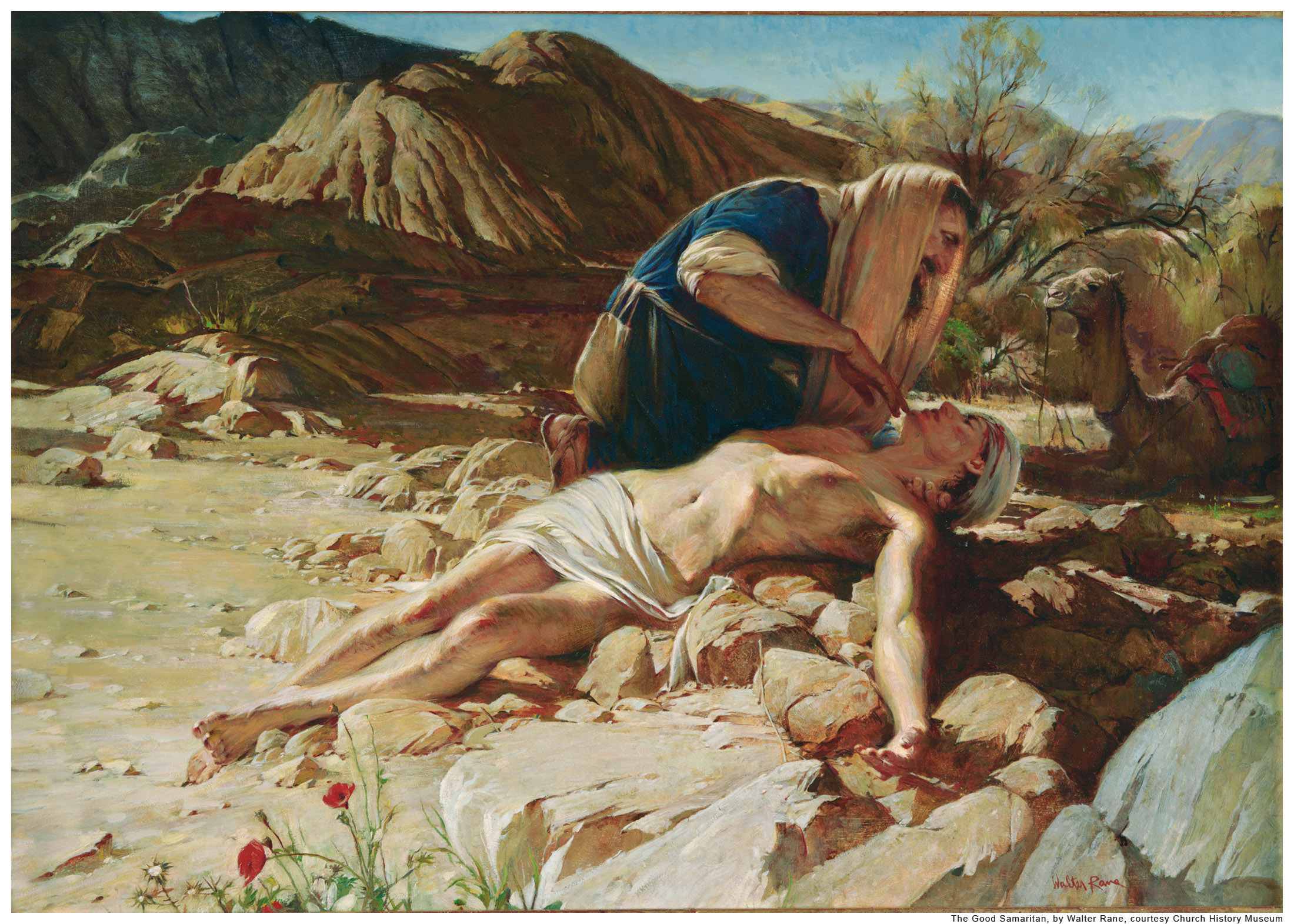
    Jesus replied with a story: “A Jewish man was traveling from Jerusalem down to Jericho, and he was attacked by bandits. They stripped him of his clothes, beat him up, and left him half dead beside the road.

     “By chance a priest came along. But when he saw the man lying there, he crossed to the other side of the road and passed him by. A Temple assistant walked over and looked at him lying there, but he also passed by on the other side.

    “Then a despised Samaritan came along, and when he saw the man, he felt compassion for him. Going over to him, the Samaritan soothed his wounds with olive oil and wine and bandaged them. Then he put the man on his own donkey and took him to an inn, where he took care of him. The next day he handed the innkeeper two silver coins, telling him, ‘Take care of this man. If his bill runs higher than this, I’ll pay you the next time I’m here.’

    Jesus always looks on the heart. He knew exactly what the man was doing so He presented a scenario that had no nuance. The man was robbed and stripped so he could not be identified by his garments. He was simply a man in need. A priest would have known the law of love in God’s teaching. He chose to not get involved. A Levite or Temple assistant also walked by without helping. To be fair to both of them the path that Jesus described was a dangerous road and stopping to help could have put the Priest or Levite in personal danger. They chose to look away and walk away. The one who stopped and risked everything was reviled in that culture as an unclean sinner. The Samaritan not only put himself at personal risk but also gave unselfishly from his own resources to make sure the victim would be cared for. His gesture was an extraordinary example of compassion and kindness. The kind of mercy that turns heads. And then Jesus asked the uncomfortable question.

    “Now which of these three would you say was a neighbor to the man who was attacked by bandits?” Jesus asked.

    The man replied, “The one who showed him mercy.”

    Then Jesus said, “Yes, now go and do the same.”

    The religious expert couldn’t even bring himself to call the man who was a good neighbor a Samaritan. He simply called him the “one who showed mercy”. Jesus drove home that there is no one outside of the mercy and compassion of God and therefore there should be none outside of our own.

    The parable Jesus told is a vital one for Christians in our contentious society. Followers of Jesus need to show kindness and compassion to the neighbors we are comfortable and especially to those we are are uncomfortable with. We can not look away when we encounter any person in need no matter what their color, status, beliefs, or behaviors might be. We are called to compassion and only that kind of faith will cause change. How did the followers of Jesus literally impact the entire world? I wrote about that in my book “When Bad Christians Happen to Good People.”

    The early church championed the concept of community responsibility. Unbelievers were often attracted to the faith because of the tangible benefits provided by the charitable, care-giving Christians. Early Christian scribe Tertullian wrote late in the second century that pagan temples spent their donations on “feasts and drinking bouts.” Donations of the Christians were used to “support and bury poor people, to supply the wants of boys and girls destitute of means and parents, and of old persons confined to the house.” The pagan emperor Julian was amazed and even cynical when he noted, “The impious Galileans support not only their poor, but ours as well.” That’s quite a shot across the bow, isn’t it? They act Christian at home and away! How dare they!

    Professor E. Glenn Hinson writes, “The early Christians impressed the culture with high moral standards and their practice of charity for all, regardless of social status” (emphasis added). Today’s church could earn a doctorate in cultural impact just by integrating those two qualities into the fabric of daily life.

    That is the kind of faith that makes a difference. We are past the point of legislating, arguing, and litigating change. How can you risk loving and having compassion for those who oppose you? By remembering the gift of grace that you received from a merciful, loving, and exceedingly patient God. Two-thousand years later we still describe those who go above and beyond as Good Samaritans. We need God to raise up an army of those selfless servants to impact this culture.


  • Redeeming the Pain of Adolescence

    Redeeming the Pain of Adolescence

    A country song titled “Don’t Laugh at Me” by Mark Wills brought back some memories about the pain of adolescent passage.

    Don’t laugh at me
    Don’t call me names
    Don’t get your pleasure from my pain
    In God’s eyes we’re all the same.

    Janis Ian sang about how hard growing up can be in her song At Seventeen.

    I learned the truth at seventeen
    That love was meant for beauty queens
    And high school girls with clear skinned smiles
    Who married young and then retired

    My junior high years were hard. I was bullied by one student. I never had the courage to share that with an adult and this is the first time I have written about it. I remember shame because boys are supposed to fight back and I didn’t. I can still remember my stomach hurting as I got ready for school.

    Now I realize that what I once considered some of the worst moments of my life have been redeemed by God as moments I am grateful I experienced. In many of those spiritual valleys you could not have begun to convince me that God was molding me or that those experiences could ever have value.

    How did God redeem those moments of teenage pain into something good? I developed a heart of compassion for those who are wounded. How did that happen? God gave me the privilege of being wounded early in my life. That last sentence seems crazy as I read back over it. That is not a sentence I would have written twenty or maybe even ten years ago. But now I can see that my struggles to fit in as an often outcast adolescent molded my heart to empathize and care about those who are hurt and ostracized by their peers.

    Had I been the coolest guy or the best athlete I likely would not have developed a sensitive spirit toward others. Many times I did not enjoy that period of my life. I would have given about anything to be the starting quarterback or the guy the cheerleaders fought over. I was almost desperate to be part of the cool group. With the benefit of hindsight I can promise you that I am grateful for every refining difficulty and problem. G.K.Chesterton wryly noted, “Do not free a camel of the burden of his hump; you may be freeing him from being a camel.” Had I been freed the burden of my “hump” (that tough teenage passage), I would not be who I am today.

    Janis Ian wrote that there were only dreams for ugly duckling girls like her. Most of us have felt that pain of rejection or not feeling like we are enough. Remember the story of the ugly duckling? The egg of a swan had found its way into the nest of the ducks. Because the new hatchling was different the awkward bird was ridiculed and mocked. But there was something the others didn’t know about this homely creature. He had the DNA of beauty and grace and later he would mature into that truth. You all know the ending. The ugly duckling matured into what was always true about him. He became a stately swan admired by all of those who had once derided him.

    I wish I had learned in my teens that I had a new identity beyond the awkward man-child identity of adolescence. Because of my trust in Jesus as Savior my spiritual DNA had already been changed as Paul told the Church at Corinth.

    This means that anyone who belongs to Christ has become a new person. The old life is gone; a new life has begun! And all of this is a gift from God, who brought us back to himself through Christ.  (I Corinthians 5, NLT)

    I was a new spiritual creation with a changed identity because of Christ. Because of God’s unmerited grace I now had the ability to mature into what God said was true about me. I was a saint and I was righteous because of Christ. Janis Ian noted that it isn’t all it seems at seventeen and she is right about that. It just took me awhile to figure that out.

  • The Importance of Finishing Strong

    The Importance of Finishing Strong

    I have attended way too many memorial services in recent years. Recently I joined family and friends to celebrate the life of Dwight Pearson. One of the ways I honor the person being remembered is by trying to take away something from their life that I can apply to my own journey. Some lives are easier to find those takeaways than others. Dwight’s life gave me a clear and important lesson to apply.

    I met Dwight about fifteen years ago when my son married his daughter Holly. I knew Dwight as having a ready smile, hearty laugh, and giving heart. His story contained some regrets and bad decisions. Relationships were hurt in that season of his life. And that is where my lesson from Dwight comes in.

    He spent the latter years of his life determined to repair those relationships. The testimonies of his children and friends indicated his success. Their words poignantly illustrated the redemptive power of forgiveness.

    My personal takeaway from the life of Dwight Pearson? The importance of finishing strong in my family and faith journey. Most of us wish we would start, maintain, and finish strong. That is not the story for most of us. But one of the great gifts of grace we can enjoy is the ability to start in this very moment to finish strong. Whether you have 30 years or 30 days you can determine to trust God with the rest of your journey. Perhaps some consequences cannot be undone but without a doubt you can make a difference with the time you have left.

    One of the ways Dwight made a real difference was through Bread Basket Ministries in Ft.Worth, Texas. This loving community is a source of emergency and supplemental groceries to senior citizens, the disabled and those going through a crisis. They also offer spiritual nourishment where people can learn about the Lord through optional Bible studies and chapel services. Dwight was an enthusiastic and faithful servant to this ministry. I was touched by the amazing diversity of people who showed up at his memorial and related stories of his giving heart. This ministry does more with less than almost any organization I have examined. All of us can give love and help to others if we are willing to get our of our comfort zones and decide to serve others.

    A bonus lesson from this uplifting celebration came from a song that Dwight requested for his service. I have probably sung “What A Friend We Have In Jesus” a hundred times or more. For some reason one section of the lyrics touched my heart.

    O what peace we often forfeit,
    O what needless pain we bear,
    All because we do not carry
    Everything to God in prayer!

    How often do I try to take control when Jesus is asking me to lean on His strength? How often do I agonize over problems when Jesus offers peace if I trust Him with my life? The truth is that none of us get out this journey unscathed. We will have pain and trials. Jesus said that very thing capped with an amazing promise.

    “I have told you these things, so that in me you may have peace. In this world you will have trouble. But take heart! I have overcome the world.” (John 16:33, NLT)

    Can we trust that? If Jesus has overcome the world then we can know that whatever comes our way we are going to ultimately be okay. What a source of peace that promise is for followers of Jesus.

    Trusting that promise gives me and you the courage to finish strong. My friend John Weber is also with Jesus today. His memorial service provided a lesson I have never forgotten.

    “God does not call us to be spectacular. He calls us to be faithful.”

    All of us can do that. And often in that humble faithfulness God can do spectacular things. I am praying that I will finish strong in the rest of my journey with my family and my faith. I pray you will trust God for that as well. Remember, it is never too late to begin that quest.


  • God Loves Me Anyway

    God Loves Me Anyway

    Today I realized that I am making real progress after only five decades of following Jesus. What a quick study I am!

    The realization is that in spite of my failings and lack of trust I am starting to believe that God loves me. Just as I am. Maybe to you that is scant progress.

    As a recovering legalist I still struggle with the concept that God does not withdraw His presence when I sin. The church of my youth seared that fear into my heart by preaching how my sins, no matter how minor, could put me “out of fellowship” with God. My congregation taught that you could reach a state of sanctification where you no longer sinned. I was not mature enough to understand that they were deceiving themselves or worse. So I was constantly living in a state of tension, fear and defeat.

    A song from a group called Sidewalk Prophets popped up this weekend on satellite radio. The title is “You Love Me Anyway” and it deals with the one of the most amazing and difficult things to understand about God’s mercy and grace.

    Only when I went off the denominational menu and studied God’s Word did I begin to see a different picture. I saw a God who still loved me when I sinned. The lyrics from Sidewalk Prophets sums up this incredible love.

    Yes then I turned away with a smile on my face
    With this sin in my heart, tried to bury Your grace
    And then alone in the night I still call out for You
    So ashamed of my life, my life, my life

    But You love me anyway
    Oh God, how You love me
    Yes You love me anyway

    That is so hard to comprehend. That kind of love is diametrically opposed to our experience in earthly relationships.

    But that is exactly the picture that Scripture paints in the story of the Prodigal Son. The son rebelled, sinned, and suffered the horrible consequences of his actions. The son realized his sin and in desperation decided to throw himself at the mercy of his father. He was convinced his sin would cause him to lose the daily privileges of being a son. But this passage tells us that nothing had changed in how the father viewed his son. The imagery is compelling. The father runs to him. That was undignified act of pure love and joy. It was a gesture of love and forgiveness but also to protect his precious child from the judgment of others.

    And while he was still a long way off, his father saw him coming. Filled with love and compassion, he ran to his son, embraced him, and kissed him. His son said to him, ‘Father, I have sinned against both heaven and you, and I am no longer worthy of being called your son.’

    “But his father said to the servants, ‘Quick! Bring the finest robe in the house and put it on him. Get a ring for his finger and sandals for his feet. And kill the calf we have been fattening. We must celebrate with a feast, for this son of mine was dead and has now returned to life. He was lost, but now he is found.’ So the party began. (Luke 15, NLT)

    The Father placed the finest robe on his wayward son who deserved nothing after his selfish and sinful actions. In the cultural context readers would have surmised that the “finest robe” was the father’s own robe that he placed on his son. The robe that was worn on the most special of occasions. The custom would have been for the son to bathe, put on clean clothes and then put on the robe. But in a stunning gesture of compassion, the father placed his robe over the filthy garments. By giving that gift to his wayward son, the father gave him a covering of acceptance and love. And the father also let everyone know that the son was forgiven, accepted and no longer to be condemned by others who had judged his behavior.

    The story is the same today. The Father ran to forgive me when I acknowledged my sin and need. While I was still dirty and clothed in filthy garments I was forgiven, accepted, justified and wrapped in the robe of righteousness. I was declared a saint because of Christ. And I was no longer condemned. Satan would have me forget that the robe of righteousness is wrapped lovingly around me. The author of lies would remind me that I still wear dirty clothing underneath. He would suggest that I need to set aside the robe until I clean myself up. That is the power of this story. The robe of righteousness is never earned. It is a gift of grace. On my worst day the Father wraps me up in this precious garment because of His Son Jesus.

    How differently we would live if we remembered that truth every day. We are saints. We are wrapped in the robe of righteousness. We are new creatures who are forgiven, accepted, and wrapped in this incomprehensible gift of grace. Even in our failure Jesus loves us anyway.

    Ever so slowly I am putting my full weight on that truth. I pray the same for you.

    Excerpts from Waking Up Slowly.

  • We All Serve Something or Somebody

    We All Serve Something or Somebody

    Bob Dylan wrote some powerful songs about his faith journey in the late 70’s. One song he composed popped up on the music feed recently. “Gotta Serve Somebody” simply says that no matter how independent, self-sufficient or in control we might try to be we still serve something or somebody.

    But you’re gonna have to serve somebody, yes indeed
    You’re gonna have to serve somebody
    Well, it may be the devil or it may be the Lord
    But you’re gonna have to serve somebody

    That lyric struck a spiritual chord because it reminded me of some seriously head and heart messing stuff I have been reading from Tim Keller. Keller wrote a thought provoking definition of idolatry and how we can substitute even good things for God.

    “Sin is building your life and meaning on anything, even a very good thing, more than on God. Whatever we build our life on will drive us and enslave us. Sin is primarily idolatry.” (Tim Keller, “Talking About Idolatry in a Postmodern Age,” www.thegospelcoalition.org)

    That is disturbing for a guy who was taught from childhood that sin is simply a list to check off to validate my righteousness. That list contained but was not limited to movies, liquor, cigarettes, dancing, shacking up, long hair and rock and roll. I thought I was doing pretty well on the idolatry commandment.

    Tim Keller’s definition of sin takes all of the fun out of self-righteous comparison and judging.

    Here is another toe-stomper from Tim Keller. “If our identity is in our work, rather than Christ, success will go to our heads, and failure will go to our hearts.”

    Who I am serving today and where I place my identity will define my actions and reactions. I wrote this in Waking Up Slowly.
    My worth is not in always being right or being the smartest guy in the room. My worth is defined by being a child of God and a friend of Jesus. When I keep my eyes on Jesus, I maintain a better perspective on every area of my life.
    It is a hard truth to admit that we often worship the things of this world because they really can be good things. God in His loving grace does not desire for us to be deprived of good and pleasurable things. He simply wants us to place them in proper order and to understand they are sources of happiness and not the source of joy. Later in the passage Paul gives one key to avoiding idolatry and where our identity should be found.

    Put on your new nature, and be renewed as you learn to know your Creator and become like Him. In this new life, it doesn’t matter if you are a Jew or a Gentile, circumcised or uncircumcised, barbaric, uncivilized, slave, or free. Christ is all that matters, and He lives in all of us. (Colossians 3:10-11, NLT)

    Your assignment is to take a moment to read verses 12-17 to see what the results of this action might look like. There will not be a quiz.

    Another key is to remember a campfire song from the Jesus movement that was, to borrow the approach of Law and Order, “ripped” from the Gospel of Matthew. (Matthew 6:33)

    Seek ye first the kingdom of God, and his righteousness;
    and all these things shall be added unto you.
    Allelu, alleluia

    Everybody is going to serve somebody or something. Who (or what) are you centering your life on today? I choose today to serve Jesus. I can’t do this by myself.

  • The God of Second Chances

    The God of Second Chances

    Joni and I love going to the Gentle Zoo in Forney, Texas. It is a fun and kid friendly place where you can feed animals by hand. Our grandson’s favorite animals to feed were the goats. They were sweet and gentle as they took the food out of your hand. Not so nice was an overbearing Llama that forced his way into every feeding opportunity. We were warned that this critter would spit in your face if you made eye contact with him. That sounded too much like a couple of people I have encountered recently so we avoided him.

    What caught my eye was a sign posted around the grounds.

    Second chances

    That made the trip more special to know that many of the animals had been rescued from abusive or neglectful situations. It even allowed me to give a bit of grace to the spittin’ Llama (but I still kept a wary distance).

    I related to the second paragraph. “Many of our critters have been disabled or injured prior to arriving at the Gentle Zoo. With a little love and care they can thrive despite their disabilities.”

    That pretty much describes the resume I brought to Jesus when I recognized my need for something or someone bigger than myself. I was disabled by sin and injured by life. Jesus gave me not a little but a LOT of love along with a bonus helping of forgiveness and grace.

    And ever so slowly I am learning to thrive in His love and acceptance. The amazing thing about God’s grace is that He is not a God of a “Second Chance”. He is a God of chance after chance after chance in this lifetime. We are never outside of God’s redeeming grace no matter how much we blow it or how often we blow it.

    How is that even possible? We write off people after one or two offenses. How can God keep forgiving after dozens or hundreds of offenses? It doesn’t make sense.

    That is because grace does not make sense to our system of accounting. I bring nothing but my sin to the table. Jesus brings His complete sacrifice on my behalf. I get forgiveness for doing nothing except acknowledging and believing what Christ has done.

    God’s forgiveness has NOTHING to do with our good works or good intentions. Ephesians 2:8-9 says, “God saved you by his grace when you believed. And you can’t take credit for this; it is a gift from God.Salvation is not a reward for the good things we have done, so none of us can boast about it. 

    So no matter what “chance” you are on God will run to meet and forgive you like the Father ran to the lost prodigal son when you turn back to Him. Not only are we given forgiveness. We also have value and a purpose as Paul points out as he continues in Ephesians.

    “For we are God’s masterpiece. He has created us anew in Christ Jesus, so we can do the good things he planned for us long ago.”

    That is a pretty good thought to begin a new week.

    Excerpted from Waking Up Slowly.