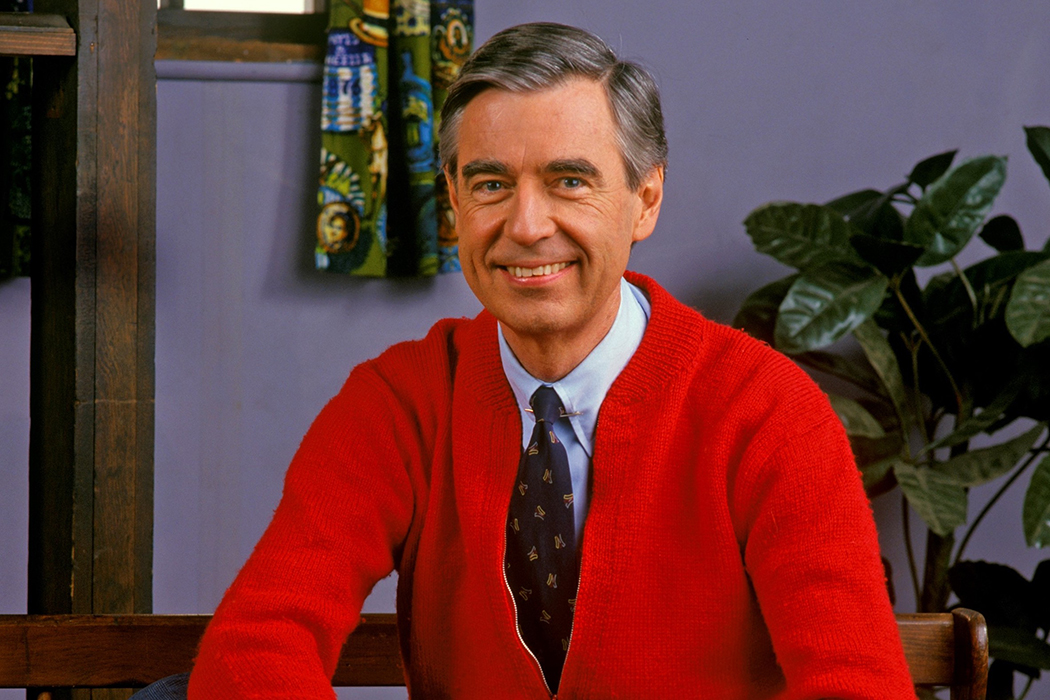
The day after a wonderful Thanksgiving Eve family gathering we checked out the new movie about the iconic children’s star Fred Rogers. A Beautiful Day in the Neighborhood is based on the real life relationship between Rogers and Esquire magazine writer Tom Junod.
In the movie the cynical journalist has been renamed Lloyd Vogel. Known for his unflinching exposes of people and events, Vogel chafes when receiving an assignment to do a “puff-piece” on television’s Mr. Rogers. Vogel approaches this story determined to find out if this gentle man is a fake. His skepticism prompts one of the best exchanges in the movie with his long suffering wife.
Lloyd Vogel: I’m profiling Mr. Rogers.
Andrea Vogel: Lloyd, please don’t ruin my childhood.
I will not offer any spoilers. I will say the movie was not what I expected. It was much, much more.
I have a confession to make and an apology to offer. I was “too cool” for Mr. Rogers. I mocked his sweater, slippers, and unique delivery. As a fellow Christian I am sorry I did not see what the one time aspiring Presbyterian minister was creating in his special neighborhood.
Fred Rogers took the truths of grace and quietly created a place of acceptance and safety.
His principles are straight out of the Gospel. And like the Jesus he studied in seminary Rogers also chose to focus his patient words toward children and those who could be tough to love.
Fred Roger’s offered this wisdom to Vogel. “I think the best thing we can do is to let people know that each one of them is precious.” That is the overriding theme of the Gospel. That Jesus was willing to give up His life for every person because they are precious.
There is no greater love than to lay down one’s life for one’s friends. John 15:13, NLT
In this neighborhood Fred Roger’s addressed the difficult topic of forgiveness. “Forgiveness is a strange thing. It can sometimes be easier to forgive our enemies than our friends. It can be hardest of all to forgive people we love. Like all of life’s important coping skills, the ability to forgive and the capacity to let go of resentments most likely take root very early in our lives.”
It is hard to imagine what a cultural bombshell this teaching was from Jesus. “Do not judge, and you will not be judged. Do not condemn, and you will not be condemned. Forgive, and you will be forgiven.”
And Jesus told the mind boggling parable of the Prodigal Son who did every single thing wrong and slithered home to find his father running to embrace and welcome him back to the family. Why? Because he was precious in his father’s eyes.
Roger’s smile radiated as he repeated this line over and over. “I like you just the way you are.” You didn’t have to try and be someone different to be in his neighborhood. And you don’t have to do anything special to be welcomed in the into the family of Jesus. Simply bring your need and trust. Just the way you are.
Then Jesus said, “Come to me, all of you who are weary and carry heavy burdens, and I will give you rest. 29 Take my yoke upon you. Let me teach you, because I am humble and gentle at heart, and you will find rest for your souls. Matthew 11:28-29, NLT
Fred Rogers never shied away from tough topics like divorce, death, and pain. “There is no normal life that is free of pain. It’s the very wrestling with our problems that can be the impetus for our growth.”
Contrary to the heretical prosperity teaching of some, Jesus never once said this journey would be without pain. He did give a priceless promise that gives me hope.
33 I have told you all this so that you may have peace in me. Here on earth you will have many trials and sorrows. But take heart, because I have overcome the world.” John 16:33, NLT
None of us gets out of this life unscathed. Followers of Jesus have the hope that those trials will be redeemed as we grow more like Him. Perhaps one of the greatest truths of grace is summed up by Rogers
“Knowing that we can be loved exactly as we are gives us all the best opportunity for growing into the healthiest of people.”
That is what grace does in the journey of a believer. Because of Jesus we are a new creation, loved exactly as we are on our best or worst days, forgiven and loved as His precious child.
Jesus also had something to say about neighbors.
“…an expert in religious law, tried to trap him with this question: 36 “Teacher, which is the most important commandment in the law of Moses?”
37 Jesus replied, “‘You must love the Lord your God with all your heart, all your soul, and all your mind.’[e] 38 This is the first and greatest commandment. 39 A second is equally important: ‘Love your neighbor as yourself.’
I can’t believe I didn’t recognize the principles of grace that Fred Rogers instilled through characters and stories into his gentle neighborhood. As I left the movie I voiced a minor complaint to Joni.
“That was really powerful but I wish they would have made a bigger deal out of his faith.”
Her reply was spot on. “He didn’t make a big deal out of his faith. He just lived it.”
And maybe that is the biggest message Fred Rogers left with his fellow believers in Christ. Maybe we should quit worrying about how others view our faith or if we are getting a cultural fair shake. Maybe we just need to live it.
