Tag: Jesus

  • We Need This Parable More Than Ever

    We Need This Parable More Than Ever

    I can’t remember a more contentious cultural climate in my lifetime. Followers of Christ are wondering how to make a difference in an unfriendly environment. I think modeling a parable related by Jesus is desperately needed today. You know the story well.

     One day an expert in religious law stood up to test Jesus by asking him this question: “Teacher, what should I do to inherit eternal life?”

    Jesus replied, “What does the law of Moses say? How do you read it?”

    The man answered, “‘You must love the Lord your God with all your heart, all your soul, all your strength, and all your mind.’ And, ‘Love your neighbor as yourself.’”

    “Right!” Jesus told him. “Do this and you will live!”

    The religious “expert” should have quit right there. Instead he did what many of us try to do when Jesus tweaks our hearts. We look for the loopholes.

    The man wanted to justify his actions, so he asked Jesus, “And who is my neighbor?”

    He was hoping to put boundaries on his personal responsibility. The Greek and Hebrew definition of neighbor would have been someone nearby or that they associate with. That clarification would have eliminated Samaritans, Gentiles, and foreigners. That was the answer the scholar was hoping for when Jesus blew the lid off his selfish hope.

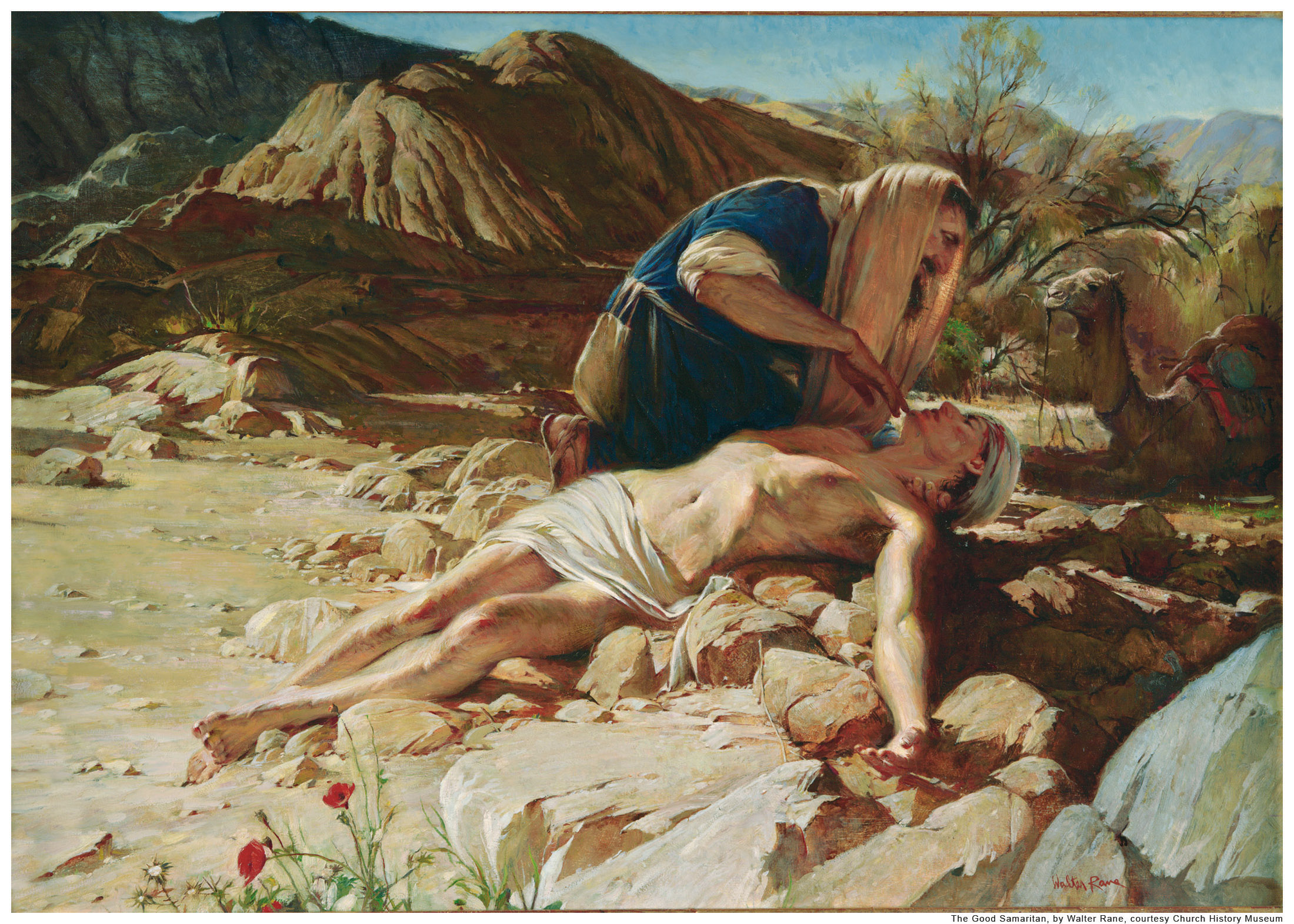
    Jesus replied with a story: “A Jewish man was traveling from Jerusalem down to Jericho, and he was attacked by bandits. They stripped him of his clothes, beat him up, and left him half dead beside the road.

    “By chance a priest came along. But when he saw the man lying there, he crossed to the other side of the road and passed him by. A Temple assistant walked over and looked at him lying there, but he also passed by on the other side.

     “Then a despised Samaritan came along, and when he saw the man, he felt compassion for him.  Going over to him, the Samaritan soothed his wounds with olive oil and wine and bandaged them. Then he put the man on his own donkey and took him to an inn, where he took care of him. The next day he handed the innkeeper two silver coins, telling him, ‘Take care of this man. If his bill runs higher than this, I’ll pay you the next time I’m here.’

    Jesus always looks on the heart. He knew exactly what the man was doing so He presented a scenario that had no nuance. The man was robbed and stripped so he could not be identified by his garments. He was simply a man in dire need. A priest would have known the law of love in God’s teaching. He chose to not get involved. He could have rationalized that touching the man would have made him unclean for priestly duties. A Levite or Temple assistant also walked by without helping. To be fair to both of them stopping to help could have put the Priest or Levite in personal danger. So the easy thing to do was look away and keep walking. The one who stopped and risked everything was reviled in that culture as an unclean sinner. The Samaritan not only put himself at personal risk but also gave unselfishly from his own resources to make sure the victim would be cared for. His gesture was an extraordinary example of compassion and kindness. The kind of mercy that turns heads. And then Jesus asked the uncomfortable question.

    “Now which of these three would you say was a neighbor to the man who was attacked by bandits?” Jesus asked. The man replied, “The one who showed him mercy.

    Then Jesus said, “Yes, now go and do the same.”

    The religious expert couldn’t even bring himself to call the man who was a good neighbor a Samaritan. He simply called him the “one who showed mercy”. Jesus drove home that there is no one outside of the mercy and compassion of God and therefore there should be none outside of our own caring.

    The parable Jesus told is a vital one for Christians in our contentious society. Followers of Jesus need to show kindness and compassion to the neighbors we are comfortable and especially to those we are are uncomfortable with. We can not look away when we encounter any person in need no matter what their color, status, beliefs, or behaviors might be. We are called to compassion and only that kind of faith will cause change.

    My friend Christ Taylor recently went to be with Jesus. He made this parable so practical in real life. His take on helping others will always be in my heart. Chris had this simple but profound approach to loving your neighbor.

    “If I can help someone I don’t need to think or pray about it. I just do it.”

    That is exactly what Jesus was saying to the religious expert. Don’t rationalize why you can’t help your neighbor. If you can help then you do it. That is how Christianity got an early foothold in an antagonistic culture.

    Professor E. Glenn Hinson writes, “The early Christians impressed the culture with high moral standards and their practice of charity for all, regardless of social status” (emphasis added). Today’s church could earn a doctorate in cultural impact just by integrating those two qualities into the fabric of daily life.

    That is the kind of faith that makes a difference. We are past the point of legislating, arguing, and litigating change. How can you risk loving and having compassion for those who oppose you? By remembering the gift of grace that you received from a merciful, loving, and exceedingly patient God. Two-thousand years later we still describe those who go above and beyond as Good Samaritans. We need God to raise up an army of those selfless servants to impact this culture. Volunteers are needed today.

  • Revisiting Grace Rules of Engagement

    Revisiting Grace Rules of Engagement

    I made a conscious decision a few years ago to focus on communicating the message of grace and identity in Christ. With that I decided to avoid the polarizing path of politics. Some have told me that is cowardly but I can honestly say there is no message more important to me than the liberating freedom of grace. I want to share the joy of living out of what Jesus has already accomplished and what God says is true about me.

    That I am a saint. A new creation. A beloved child of God. I relate to the mission statement of Paul when he wrote these words.

    But my life is worth nothing to me unless I use it for finishing the work assigned me by the Lord Jesus—the work of telling others the Good News about the wonderful grace of God. (Acts 20:24, NLT)

    I feel called to be a messenger of hope and grace. Plus I feel like the negative team has a pretty full roster of contributors. 

    I still believe that is my calling with these humble ramblings. But how does grace enter into the conversation when we have sincere disagreements over cultural and political issues?

    It is fascinating how two people can look at the same information and reach completely opposite conclusions. So I am going to offer the “Grace Rules of Engagement” as a roadmap for civil discussion. 

    • Sincere followers of Jesus can look at cultural or political issues and have very different opinions. Jesus loves His children on both sides of the argument.

    I know I have changed my views on some cultural issues over my years of walking with Jesus. I was a child in the era when divorce was a mortal sin. I absolutely am committed to the idea of a husband and wife taking their vows seriously. But I learned that the cultural shame of divorce caused many Christian women to feel trapped in relationships of abuse. Clearly that was not the desire of a loving Heavenly Father who ordained marriage. In those sad situations it is necessary to divorce an abusive spouse. In the pulpits of my youth the message was no divorce outside of adultery was ever justified. I had a blind spot about how a declaration that appeared Biblical could foster abuse. So many issues we discuss have similar and complex nuances. We need to discuss, not demonize.

    • The goal of a discussion should not be to win.

    Thoughtful discourse is impossible when one of the participants only cares about winning the debate. The goal of any conversation should be graceful exchange of ideas without rude interruptions, condescending gestures, or angry exchanges. I would rather have a goal of being winsome instead of winning. That attitude fosters conversation. 

    • People of different viewpoints should commit to listen. Nothing shows respect more than carefully listening to the arguments of those with whom you disagree and then gently offering thoughtful responses. 

    Listen to talking heads on television news shows as they “discuss” different points of view. As soon as one side starts talking the other shakes their head, smirks, and then interrupts and talks over the other person. How is that going to persuade anyone? Yet we tend to do the same thing when we have significant disagreements with people of faith. Listen. Really listen. Let them finish their point. Then respond in grace.

    • Ask questions.

    You will not influence another person by arguing. The way to connect is to ask questions and try to understand why they feel the way they do. I have found that many times people I talk with don’t have a solid reason for their feelings. That can be a opening to honestly discuss difficult topics. 

    • Climb out of your bubble

    Find out what the other person is reading and watching. Expose yourself to different points of view and encourage those you have disagreements with to do the same. If you are confident in your beliefs there should be no fear in being exposed to differing viewpoints.

    • All of us are a work in process.

    Every child of God is in process. I am a very different Christian than I was 20, 10, or even 5 years ago. I am growing (hopefully) in grace and truth. I strongly believed and said things years ago that I am grieved about today. Thankfully God was patiently working with my heart and gently shining the light of the Holy Spirit on my blind spots. I need to give that grace to others. 

    • Pray for wisdom and grace then leave the results to God.

    So what is the goal when you have sincere disagreements with another believer over cultural issues? Use the “Grace Guidelines” and relax. God may be using you to plant seeds in the heart of the other person. Maybe you have a blind spot that needs the refining work of the Holy Spirit. Share your heart with love and kindness and be open to the possibility that you may be the one who needs to change your heart.

    • Grace never cancels

    Grace does not “cancel”. Grace does not shame. Grace does not answer anger with anger. The person you totally disagree with may be crying out of pain and deep wounding. Perhaps a gentle answer will give hope. Grace does not lash out when challenged. Grace is kind and gentle.

    Being graceful can be a pain in the hind regions but it is what we are called to offer to others. Paul addresses this to the church at Colossae. 

    Since God chose you to be the holy people he loves, you must clothe yourselves with tenderhearted mercy, kindness, humility, gentleness, and patience. Make allowance for each other’s faults, and forgive anyone who offends you. Remember, the Lord forgave you, so you must forgive others. Above all, clothe yourselves with love, which binds us all together in perfect harmony. And let the peace that comes from Christ rule in your hearts. For as members of one body you are called to live in peace. And always be thankful.

    Let the message about Christ, in all its richness, fill your lives. Teach and counsel each other with all the wisdom he gives. Sing psalms and hymns and spiritual songs to God with thankful hearts. And whatever you do or say, do it as a representative of the Lord Jesus, giving thanks through him to God the Father.

    Colossians 3:12-17, NLT

    Perhaps the most important thing all of us can do to further the unity in the body of Christ is to memorize that passage and try to implement those words for 30 days. By the grace of God it could become a habit.

    Be kind to those who disagree and remember the words of author Alexander MacLaren. “Kindness makes a person attractive. If you would win the world, melt it, do not hammer it.”

  • The Yoke of Jesus is Easy? Really?

    The Yoke of Jesus is Easy? Really?

    This has been a tough season of life for many people I care deeply about. My heart feels heavy as I remember the words of Jesus.

    “Come to me, all of you who are weary and carry heavy burdens, and I will give you rest. Take my yoke upon you. Let me teach you, because I am humble and gentle at heart, and you will find rest for your souls. For my yoke is easy to bear, and the burden I give you is light.” (Matthew 11:28-30)

    I wrote about this passage in my book Stay: Lessons My Dogs Taught Me about Life, Loss, and Grace.

    What did Jesus mean by that statement, “My yoke is easy”? Clearly, the burdens of life are heavy. There is nothing easy about heartache, pain, and loss.

    I reread Jesus’ inviting words: “Come to me.” No one needs to go through life’s difficulties alone, but the truth is that Jesus will not force Himself on you. The wonderful news is you have permission to come to Jesus whenever you are ready.

    In Jesus’ day, oxen were harnessed together with a wooden yoke, a beam that fit over the animals’ shoulders to keep them moving together in one direction. The oxen shared the effort to accomplish the task. That idea fit quite well into my performance-driven faith. Of course Jesus is with me, but I decided that I had to pull my weight. The only problem with my view was that it was unbiblical and even dangerous.

    In this passage Jesus is not speaking of physical burdens. Jesus was talking about the yoke of the Torah, the yoke of the law of Moses, which his Jewish listeners would have known well. The Old Testament yoke represented submission to authority. The Jews knew that the law was impossible to keep, but they kept trying. Jesus was offering them His yoke of grace. Compared to the impossible standards of the Pharisees and the law, His way was easy. Agreed.

    Jesus makes another important offer. “Let me teach you, because I am humble and gentle at heart.”

    For years, I strained to pull my weight by self-effort, while Jesus quietly offered a better way. I don’t have to figure this out to be loved by Jesus. I just need to be available.

    “Let me teach you.”

    I wore myself out trying to do more to please Him, even as He whispered, “I am humble and gentle at heart. Your trust and faith pleases Me, not your joyless self-efforts to be better.”

    Members of that agrarian culture of Jesus’ time would have known that you train a young ox by pairing it with an experienced ox. The mature ox would carry the bulk of the burden as the younger one walked by its side and learned. That is a beautiful image. Jesus walking alongside me, but carrying the bulk of the burden (if not all of it) as I learn from Him. I don’t need to strain myself in an attempt to shoulder everything on my own; Jesus wants me to be willing to gently submit to His strength and not rely solely on mine. He is extending an offer to those who are exhausted, emotionally drained, and buckling under what life brings. Pain and loss are a given in this life, but it is comforting to know that I can find rest for my weary soul, even as I grieve and doubt and waver. When I am exhausted, I can take time and seek respite in Him.

    Corrie Ten Boom wisely wrote these words. “Worry does not empty tomorrow of its sorrow. It empties today of its strength.” That strength is found in Jesus. He is your strength and your hope. Keep your eyes on Jesus and the words of a classic old church hymn will begin to ring true in your heart.

    Turn your eyes upon Jesus,
    Look full in His wonderful face,
    And the things of earth will grow strangely dim,
    In the light of His glory and grace.

  • God Redeems Fiery Trials

    God Redeems Fiery Trials

    My lovely wife loves pottery, so one of my “sacrificial” ways to love Joni is to accompany her to pottery shops. Guys refer to that as “hitting behind the runner” or “taking the charge.” Once we visited a shop where the artisans were making vases and pots right before our eyes, surrounded by shelves of the colorful, beautiful, and functional finished products.

    While Joni looked around, I watched a potter take a nondescript lump of clay and skillfully make a unique creation. This verse from Isaiah came to mind.

    O Lord, you are our Father.
    We are the clay, and you are the potter.
    We all are formed by your hand.  (Isaiah 64:8)

    I was fascinated by the complexity of the process. The potter must make sure that no dirt or impurities are in the clay. These unwanted materials will make the pot weak and unusable for its intended purpose. God desires to do the same with us. Impurities (sin) weaken us and keep us from our intended purpose.

    The potter kneads the clay to ensure that there are no air bubbles, otherwise the pot might crack when fired in the kiln. In my life, my “air bubbles” are pockets of resistance when I decide I must control my destiny instead of trusting God. I can appear to be molded and conformed to God’s image, but I have unseen “bubbles” of pride and anger and control. These self-generated bubbles can cause me to crack under the heat of adversity.

    The metaphors that Scripture uses are so powerful when we take the time to understand context and culture. The newly formed pottery, called “greenware,” is carefully placed on a shelf to air-dry before the next step. It is brittle and easily broken. Something else needs to happen to permanently set the object’s shape and make it strong and usable. The clay must endure the fire of the kiln.

    Trials by fire can have that same effect on us as followers of Jesus. Trials can make us stronger and set our shape as His followers. Or, if we are unprepared, the fire of life’s trials can cause us to crack and make us useless for His plan.

    I can choose to be content in my “greenware” state, brittle and useless for service. But God knows that it is in the trials of fire that we are strengthened and most effective. It is nearly always in that uncomfortable adversity that the true beauty of our creative process is revealed. I cannot think of an instance of significant growth in my life that has happened without the refining heat of trials.

    There are a couple of huge differences between the earthly potter and God as the Potter. When the earthly potter finds a bad piece of clay, he discards it. Our heavenly Potter patiently works with us even when we seem misshapen and worthless. A shattered piece of pottery is often thrown out. But our heavenly Father can take the shards of our brokenness and reshape us into something beautiful and effective for Him.

    The words of the apostle James make more sense in the context of the Potter’s process.

    Consider it pure joy, my brothers, whenever you face trials of many kinds, because you know that the testing of your faith develops perseverance. (James 1:2-3, NIV)

    There is no joy in the trial, but there is joy in the knowledge of how God uses such events in our lives. If you are in the midst of a trial or about to face a trial, take comfort that God desires for you to emerge strengthened and beautiful and useful. One potter said that the greatest thing about making pots is that each lump of clay has near-infinite potential. The lump of clay that is me and the lump of clay that is you have infinite potential because we have an infinite God who is patient and good. We should not fear or run from fiery trials. What happens when we endure them while trusting God is worth the cost.

    An excerpt from Stay: Lessons My Dogs Taught Me about Life, Loss, and Grace. Check it out here.

  • What Would My Last Message Be?

    What Would My Last Message Be?

    When I was a little boy I remember the standard prayer at bedtime. I know it was meant to comfort but one line always freaked me out.

    Now I lay me down to sleep.

    I pray the Lord my soul to keep.

    If I should die before I wake,

    Wait? What? If I should die before I wake? I think I will just stay awake for awhile thank you very much.

    Six decades later that prayer makes a lot more sense. If I should die before I wake I believe I will be in the presence of Jesus. I am not anxious to leave this life but I am not afraid.

    I talked about loss in my book Stay: Lessons My Dogs Taught Me about Life, Loss, and Grace. I wrote that “preparing for death is preparing for life,” a principle that has radically changed my perspective. The corollary truth is when you are not afraid to die you are not afraid to live. Recognizing how finite my existence is allows me to live in the moment and enjoy God’s tender mercies every morning. I am forgiven so I don’t have to live in regret of the past. He is in control so I don’t have to live in fear of the future. I can live right now in freedom and peace.

    The other thing I ponder is what message would I like to communicate as my final word? I have been blessed with some wonderful friends and colleagues who would likely say some nice things about me. I would like them to understand a very important truth. I learned some great lessons from my Dad and others as I was growing up. But I can tell you with complete assurance that my life would have likely gone off the rails without my relationship with Jesus. His love both restrained and sustained me. I believe my insecure and selfish heart would have taken me down a different path without my faith. Any quality that you find positive in my life has been given or enhanced through my relationship with Jesus. Anytime I have disappointed or did not show love it was because I took my eyes off of Him.

    Paul writes these words in Philippians.

    And now, dear brothers and sisters, one final thing. Fix your thoughts on what is true, and honorable, and right, and pure, and lovely, and admirable. Think about things that are excellent and worthy of praise. Keep putting into practice all you learned and received from me—everything you heard from me and saw me doing. Then the God of peace will be with you. (Philippians 4, NLT)

    I would like to paraphrase Paul’s words for my final message.

    “And now, dear brothers and sisters, one final thing. I hope you saw in my life some things that were true, and honorable, and right, and pure, and lovely, and admirable. Whatever you might have received from me grew out of the sustaining love, grace, and peace of God.”

    I know my heart. I know the crossroads I came to in different seasons of my life and how God gracefully and lovingly rescued me over and over. So my final message to my believing friends would be one of encouragement and hope.

    Trust God and trust who He says you are because of the finished work of Jesus. Believe you are forgiven of all sins past, present, and future. Wholly accept that you are a brand new creation and live in grateful freedom. Drink in the inexhaustible grace of God every day. Allow God to love you as His beloved and then pay that love forward for His glory. Look through the lens of grace and you will find sacred moments in every single day. Recognize that everything about your walk with Jesus is a gift of grace. It is all about the finished work of Jesus on the Cross. At the moment you believe that Jesus is the way to salvation you are gifted with everything you need to live for Him.

    Forgiveness.
    Security.
    The Spirit of God dwelling in your heart.
    A new identity.
    The hope of eternity with Jesus.
    Grace and love that is completely unrelated to your performance.

    Those gifts make me want to serve God out of gratitude and not out of begrudging compliance to avoid judgment.

    For my friends who don’t share my faith I would ask one favor. Don’t focus on Christians who fail. Focus on Christ who succeeded.

    Jesus conquered death. He paid for your sins. I would ask you to examine the impact of Jesus on His culture. It was the message of Christ that gave value to women, children, the poor, and the ignored. When you study His words and life you will see that many of His followers have fallen short, including me. Jesus also taught that some would claim to be His followers who were not in any way known to Him. Those counterfeiters get lumped in with true followers.

    So my final request would come out of deep love for you. Examine the claims of Jesus with an open heart and mind. Don’t reject Christ because of Christians. That is an easy thing to do. Read the Gospel of John and ask for the Spirit to reveal truth to you. If you choose to reject the claims of Jesus I would sadly accept that decision. If I am wrong about my eternal destiny I would still have no regrets about the way the teachings of Jesus influenced my life. I would do it all over again.

    I can’t force you to follow Jesus. I hope I can be a small influence for you to thoughtfully and honestly examine the life and claims of Jesus. Following Jesus changed everything in my journey. I would not be a good and loving friend if I did not share that with you.

  • I’m Gonna Miss You My Friend

    I’m Gonna Miss You My Friend

    The title is from the chorus of a song by Toby Keith written after his friend Wayman Tisdale passed away. The lyrics hit my heart when I left the hospital after visiting my dear friend Chris Taylor. His time is near and it hurt so much to see his decline.

    But it was still a sweet time to tell my friend I love him. Over the years he has made me laugh so many times. We have shared heartaches. Wonderful memories that made me smile. Chris and I were dangerous together. You could count on the sarcasm train coming down the tracks full speed anytime we convened.

    But Chris is also an incredibly kind man who served others for many years as a Wylie, Texas Police officer and dedicated follower of Jesus. One of his sayings will stick with me until my time comes. Chris always said this about serving others.

    “If I can help someone I don’t need to think or pray about it. I just do it.”

    We can use love one another as a slogan too often without feet and hands. But Chris lived that philosophy of being there to help others without fanfare.

    One of the lyrics from Toby Keith’s song fits beautifully here.

    You showed me how I am supposed to live
    Now you showed me how to die

    That is one of the most powerful things I have seen over and over in the lives of dedicated followers of Jesus. They pass with confidence and peace in their next destination. Even through the pain and tears those flashes of his wonderful humor were present. The very real hope in that room was this promise from Jesus.

    “Don’t let your hearts be troubled. Trust in God, and trust also in me. There is more than enough room in my Father’s home. If this were not so, would I have told you that I am going to prepare a place for you?
    (John 14, NLT)

    Soon my friend Chris will experience that glorious promise. Toby Keith says it perfectly in the chorus of his song “Crying For Me”.

    I’m going to miss that smile
    I’m going to miss you my friend
    Even though it hurts the way it ended up
    I’d do it all again

    My friend looked weak as I leaned over to give him a hug. I did not expect what I received. I got a bear hug that I would not have believed he was capable of giving. I will never forget that moment. When I left I said a very intentional thing that I believe with all of my heart.

    “See you later.”

    I completely trust that promise of eternity given to us by the finished work of Jesus.

    So I will miss my friend but once again I defer to Toby Keith.

    I’m not crying’ cause I feel so sorry for you
    I am crying’ for me

    I am crying for Chris’s beautiful family. For his dear friends and colleagues. For me. But I know on the scale of eternity my time is also very near. I cling to the promise of eternity today and I look forward to that reunion in heaven.

  • Forgiveness Does Not Appear To Be An Option

    Forgiveness Does Not Appear To Be An Option

    I think forgiveness is the most challenging thing Jesus commands us to do. I have tried to argue with God about forgiveness and whether someone “deserves” mercy.

    Scripture can be so annoying sometimes. Paul threw down an incredible statement to the Ephesian church.

    Be kind to each other, tenderhearted, forgiving one another, just as God through Christ has forgiven you.
    (Ephesians 4:32, NLT)

    That is a very tall order and one that is impossible to do without remembering how much I have been forgiven. If you say something nasty about me and ask for forgiveness, I will almost certainly grant it. If you do it again and ask forgiveness, I will probably forgive you. If you do the same thing again and ask forgiveness, I will most likely respond ungraciously and ask you to “prove” you are sorry.

    Yet that illustration is exactly what I do in my relationship with God every day. I have asked Him to forgive the same sin dozens, even hundreds of times. Still His Word tells me I am forgiven and He loves me just the same as the first time I confessed that sin. That is how God has forgiven me through Christ. I should respond accordingly, forgiving each and every offense out of profound gratitude. Do you see any way around the obvious command to forgive? Me either.

    Bottom line: we are commanded to forgive as we have been forgiven. Forgiveness may well be the missing ingredient to the healing of most relationships. Forgive the one who wounded you. Forgive yourself and seek forgiveness if you are the one who wounded. Perhaps your efforts will not result in reconciliation. That is sad but ultimately okay. What if the other person does not deserve to be forgiven? Consider Jesus as He looked down in agony from the cross.

    Jesus said, “Father, forgive them, for they don’t know what they are doing.” And the soldiers gambled for his clothes by throwing dice. (Luke 23:34, NLT)

    I can say with complete confidence that I have not endured the level of wounds, betrayal, mocking, and abuse that Jesus experienced. Yet He could look at those evil perpetrators and ask His Father to forgive them. That gives me some perspective. Perhaps my situations are forgivable, with His help and only with His help.

    I have spent a lot of unhappy moments not enjoying the freedom the Lord intended because I did not want to forgive someone who hurt me. I grieve to think of how I have stubbornly refused to forgive others for real and/or perceived slights over the years. I can imagine Jesus looking at me with sadness (not condemnation) because I have not fully comprehended the magnitude of the debt that has been erased from my account because of Him. I can hear Him saying,

    “Dave, when you choose to hold onto bitterness, you shortchange yourself on joy and peace.”

    If I cannot forgive, I have forgotten or never comprehended how much I have been forgiven.

    Taken from Stay: Lessons My Dogs Taught Me about Life, Loss, and Grace.

    How quickly I forget. I forget how much I have been forgiven. I forget how much I am loved by Jesus. I forget that I am a brand new creation. I forget I am righteous because of the finished  work of Christ. I forget that there is no condemnation in Christ. I forget that I am a beloved child of God and He is for me. I forget that He has my back and He has me in His hand forever. I am forgetful.

    But thank God He does not forget His promises. More than anything I need to remember that today.