Tag: parable

  • The Parable of the Prodigal is Game Changing

    The Return of the Prodigal Son, 1773 | Pompeo Batoni | Painting Reproduction

    God initiates salvation. The plan is so radical that it feels otherworldly. Salvation is complete and God’s embrace shows His desire to know us as His beloved children. No matter what you have done the Father stands ready to embrace and redeem. That flies in the face of what many of us have experienced in love relationships.

    But that is exactly the picture that Scripture paints in the story of the Prodigal Son. The son rebelled, sinned, and suffered the horrible consequences of his actions. The son realized his sin and in humble desperation decided to throw himself at the mercy of his father. Clearly the sins of the son would cause him to lose the daily privileges of being a son. But this passage tells us that nothing had changed in how the father viewed his son. The son was sure his behavior had estranged him from his father. The imagery is compelling. The father runs to him. That was undignified act of pure love and joy. The father would never have done that in common practice. His act was a gesture of love and forgiveness but also to protect his precious child from the judgment of others.

    And while he was still a long way off, his father saw him coming. Filled with love and compassion, he ran to his son, embraced him, and kissed him. His son said to him, ‘Father, I have sinned against both heaven and you, and I am no longer worthy of being called your son.’

    “But his father said to the servants, ‘Quick! Bring the finest robe in the house and put it on him. Get a ring for his finger and sandals for his feet. And kill the calf we have been fattening. We must celebrate with a feast, for this son of mine was dead and has now returned to life. He was lost, but now he is found.’ So the party began. (Luke 15, NLT)

    The Father placed the finest robe on his wayward son who deserved nothing after his selfish and sinful actions. In the cultural context readers would have surmised that the “finest robe” was the father’s own robe that he placed on his son. The robe that was worn on the most special of occasions. The custom would have been for the son to bathe, put on clean clothes and then put on the robe. But in a stunning gesture of compassion, the father placed his robe over the filthy garments. By giving that gift to his wayward son, the father gave him a covering of acceptance and salvation. And the father also let everyone know that the son was forgiven, accepted and no longer to be condemned by others who had judged his behavior. And you might remember that most upset person in the story was the older brother who had done everything right. The older brother had not yet experienced what author Edwin Lutzer describes as the prerequisite for grace.

    “When the mask of self-righteousness has been torn from us and we stand stripped of all our accustomed defenses, we are candidates for God’s generous grace.”

    The story is the same today. The Father ran to forgive you when you acknowledged your sin and need. While you were still dirty and clothed in filthy garments you were forgiven, accepted, justified and wrapped in the robe of righteousness. You were declared a saint because of Christ. And you were no longer condemned. Satan would have you forget that the robe of righteousness is wrapped lovingly around you. The author of lies would remind you that you still wear dirty clothing. He would suggest that you need to set aside the robe until you clean up yourself and your garments. That is the power of this story. The robe of righteousness is never earned. It is a gift of grace. On my worst day the Father wraps me up in this precious garment because of His Son Jesus.

    How differently we would live if we remembered that truth every day. I am a saint. I am wrapped in the robe of righteousness. We are new creatures who are forgiven, accepted, and wrapped in this incomprehensible gift of grace. Even in our failure Jesus loves us anyway.

    I wish that everyone who believes the Gospel would truly believe that they are a brand new creation. Recreated as a saint with complete freedom in Christ. Adopted as a child of God. Forgiven forever. And that all of those things are completely true because of Jesus.

  • The Most Needed Parable of Jesus in this Culture?

    I can’t remember a more contentious cultural climate in my lifetime. Followers of Christ are wondering how to make a difference in an unfriendly environment. I think modeling a parable related by Jesus is desperately needed today. You probably know the story well.

    One day an expert in religious law stood up to test Jesus by asking him this question: “Teacher, what should I do to inherit eternal life?”

    Jesus replied, “What does the law of Moses say? How do you read it?”

    The man answered, “‘You must love the Lord your God with all your heart, all your soul, all your strength, and all your mind.’ And, ‘Love your neighbor as yourself.’”

    “Right!” Jesus told him. “Do this and you will live!”

    The religious “expert” should have quit right there. Instead he did what many of us try to do when Jesus tweaks our hearts. We look for the loopholes.

    The man wanted to justify his actions, so he asked Jesus, “And who is my neighbor?”

    He was hoping to put boundaries on his personal responsibility. The Greek and Hebrew definition of neighbor would have been someone nearby or that they associate with. That clarification would have eliminated Samaritans, Gentiles, and foreigners. That was the answer the scholar was hoping for when Jesus blew the lid off his selfish hope.

    Jesus replied with a story: “A Jewish man was traveling from Jerusalem down to Jericho, and he was attacked by bandits. They stripped him of his clothes, beat him up, and left him half dead beside the road.

    “By chance a priest came along. But when he saw the man lying there, he crossed to the other side of the road and passed him by. A Temple assistant walked over and looked at him lying there, but he also passed by on the other side.

    “Then a despised Samaritan came along, and when he saw the man, he felt compassion for him. Going over to him, the Samaritan soothed his wounds with olive oil and wine and bandaged them. Then he put the man on his own donkey and took him to an inn, where he took care of him. The next day he handed the innkeeper two silver coins, telling him, ‘Take care of this man. If his bill runs higher than this, I’ll pay you the next time I’m here.’

    Jesus always looks on the heart. He knew exactly what the man was doing so He presented a scenario that had no nuance. The man was robbed and stripped so he could not be identified by his garments. He was simply a man in dire need. A priest would have known the law of love in God’s teaching. He chose to not get involved. He could have rationalized that touching the a potentially dead man would have made him unclean for priestly duties. A Levite or Temple assistant also walked by without helping. To be fair to both of them stopping to help could have put the Priest or Levite in personal danger. So the easy thing to do was look away and keep walking. The one who stopped and risked everything was reviled in that culture as an unclean sinner. The Samaritan not only put himself at personal risk but also gave unselfishly from his own resources to make sure the victim would be cared for. His gesture was an extraordinary example of compassion and kindness. The kind of mercy that turns heads. And then Jesus asked the uncomfortable question.

    “Now which of these three would you say was a neighbor to the man who was attacked by bandits?” Jesus asked. The man replied, “The one who showed him mercy.

    Then Jesus said, “Yes, now go and do the same.”

    The religious expert couldn’t even bring himself to call the man who was a good neighbor a Samaritan. He simply called him the “one who showed mercy”. Jesus drove home that there is no one outside of the mercy and compassion of God and therefore there should be none outside of our own caring.

    The parable Jesus told is a vital one for Christians in our contentious society. Followers of Jesus need to show kindness and compassion to the neighbors we are comfortable with and especially to those we are are uncomfortable with. We can not look away when we encounter any person in need no matter what their color, status, beliefs, or behaviors might be. We are called to compassion and only that kind of faith will cause change.

    My friend Chris Taylor has gone to be with Jesus. He made this parable so practical in real life. His take on helping others will always be in my heart. Chris had this simple but profound approach to loving your neighbor.

    “If I can help someone I don’t need to think or pray about it. I just do it.”

    That is exactly what Jesus was saying to the religious expert. Don’t rationalize why you can’t help your neighbor. If you can help then you do it. That is how Christianity got an early foothold in an antagonistic culture.

    Professor E. Glenn Hinson writes, “The early Christians impressed the culture with high moral standards and their practice of charity for all, regardless of social status” (emphasis added).

    Today’s church could earn a doctorate in cultural impact just by integrating those two qualities into the fabric of daily life.

    That is the kind of faith that makes a difference. We are past the point of legislating, arguing, and litigating change. How can you risk loving and having compassion for those who oppose you? By remembering the gift of grace that you received from a merciful, loving, and exceedingly patient God. Over two-thousand years later we still describe those who go above and beyond as Good Samaritans. We need God to raise up an army of those selfless servants to impact this culture. Volunteers are needed today.

  • Is Grace Fair?

    Is Grace Fair?

    I write a lot about where our hope truly lies and how we need to be a positive light in a negative world. I came upon this wise advice for social media posters from the Gospel of John.

    “Stop grumbling among yourselves,” Jesus answered. (John 6:43)

    I laughed when I read that and thought this might become my new life verse for this very negative political season. The verse follows a section where Jesus talks about how He is the bread of life and has come from Heaven. This was just too much for the locals who knew Him as the kid raised by Mary and Joseph down at the carpenter shop. But the message is timeless. I need to stop grumbling and start living out of who God says I am as His child. Maybe that is why God calls me His child because I sure can be childish at times.

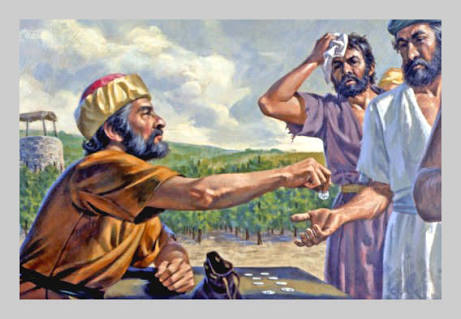
    The grumbling verse reminded me of one of my favorite grace parables. A vineyard owner hired some workers early in the morning to help bring in the harvest. Jesus continues the story.

    “At five o’clock that afternoon he was in town again and saw some more people standing around. He asked them, ‘Why haven’t you been working today?’ “They replied, ‘Because no one hired us.’ “The landowner told them, ‘Then go out and join the others in my vineyard. (Matthew 20:6-7)

    So far the story is nice. A kind and compassionate man wants to help some poor folks who had no work. They could work an hour and at least get a tiny bit for their effort. But Jesus is about to turn the “fairness” doctrine over like a table in the Temple.

    “That evening he told the foreman to call the workers in and pay them, beginning with the last workers first. When those hired at five o’clock were paid, each received a full day’s wage. When those hired first came to get their pay, they assumed they would receive more. But they, too, were paid a day’s wage. When they received their pay, they protested to the owner, ‘Those people worked only one hour, and yet you’ve paid them just as much as you paid us who worked all day in the scorching heat.’

    “He answered one of them, ‘Friend, I haven’t been unfair! Didn’t you agree to work all day for the usual wage? Take your money and go. I wanted to pay this last worker the same as you. Is it against the law for me to do what I want with my money? Should you be jealous because I am kind to others?’

    “So those who are last now will be first then, and those who are first will be last.” (Matthew 20:8-16, NLT)

    Can’t you just see it? The grumbling of the sweaty and exhausted all day workers decrying that they had been treated unfairly yet the truth is they got exactly the wage they agreed upon. I wondered about the reaction of the latecomers. Did they gloat about their luck? I don’t think so. I imagine they wept at the kindness of an unmerited gift given by a unexpectedly kind man. At 4 pm they faced the prospect of going home with nothing to provide for their family but two hours later they had been given, not earned, a full days wage! Think of the joy as the men went home and excitedly told about this amazing generosity. The family likely gathered around and touched the denarius like a sacred gift from Heaven. What a contrast of joy from a once forgotten group of men juxtaposed against the grumbling of the people who had done the “right” thing and expected to be treated better. What a picture of grace! We don’t earn grace by a full day or one hour effort. Grace is a gift. Grace is an unearned gift of love to be savored, appreciated, and treasured.  Brennan Manning wrote about the incomprehensibility of grace to the American mindset.

    My life is a witness to vulgar grace — a grace that amazes as it offends. A grace that pays the eager beaver who works all day long the same wage as the grinning drunk who shows up at ten till five. A grace that hikes up the robe and runs breakneck toward the prodigal reeking of sin and wraps him up and decides to throw a party, no ifs, ands, or buts. A grace that raises bloodshot eyes to a dying thief’s request — “Please, remember me” — and assures him, “You bet!”…This vulgar grace is indiscriminate compassion. It works without asking anything of us. It’s not cheap. It’s free, and as such will always be a banana peel for the orthodox foot and a fairy tale for the grown-up sensibility. Grace is sufficient even though we huff and puff with all our might to try and find something or someone that it cannot cover. Grace is enough…

    Indeed.

    My old nature screams that people who make bad decisions over and over get what they “deserve.” They don’t “deserve” to be pursued and loved and restored. They made their bed—now let them lie in it. But there is a small quiet voice in my heart that tells me that they have value. That they are loved by their Creator. And that voice asks who am I to decide who “deserves” anything? Did I “deserve” this amazing gift? The honest answer is no way. Remembering that amazing grace bestowed makes it way easier to love and treat kindly that person who disagrees with you.

    Would you open the outrageous gift of grace and accept it as a mind blowing outpouring of love from a Father who delights in you? Grace doesn’t make sense. Grace is outrageous. And the amazing thing I find over and over is this simple truth. Grace changes hearts. It is the word the church in America needs to model more than ever. We are given inexhaustible grace. We have more than enough to share.