Tag: grace

  • We Need This Parable More Than Ever

    We Need This Parable More Than Ever

    I can’t remember a more contentious cultural climate in my lifetime. Followers of Christ are wondering how to make a difference in an unfriendly environment. I think modeling a parable related by Jesus is desperately needed today. You know the story well.

     One day an expert in religious law stood up to test Jesus by asking him this question: “Teacher, what should I do to inherit eternal life?”

    Jesus replied, “What does the law of Moses say? How do you read it?”

    The man answered, “‘You must love the Lord your God with all your heart, all your soul, all your strength, and all your mind.’ And, ‘Love your neighbor as yourself.’”

    “Right!” Jesus told him. “Do this and you will live!”

    The religious “expert” should have quit right there. Instead he did what many of us try to do when Jesus tweaks our hearts. We look for the loopholes.

    The man wanted to justify his actions, so he asked Jesus, “And who is my neighbor?”

    He was hoping to put boundaries on his personal responsibility. The Greek and Hebrew definition of neighbor would have been someone nearby or that they associate with. That clarification would have eliminated Samaritans, Gentiles, and foreigners. That was the answer the scholar was hoping for when Jesus blew the lid off his selfish hope.

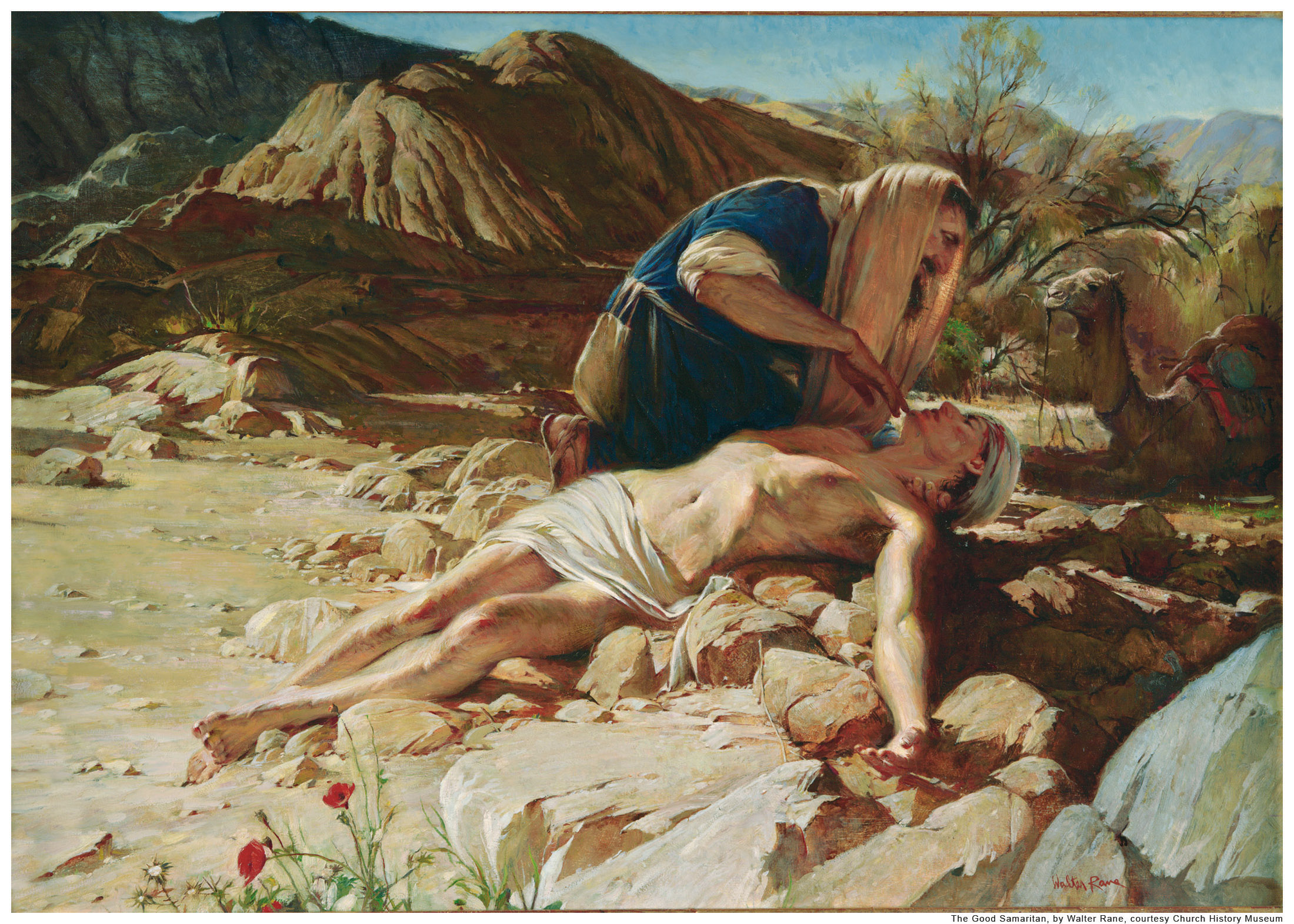
    Jesus replied with a story: “A Jewish man was traveling from Jerusalem down to Jericho, and he was attacked by bandits. They stripped him of his clothes, beat him up, and left him half dead beside the road.

    “By chance a priest came along. But when he saw the man lying there, he crossed to the other side of the road and passed him by. A Temple assistant walked over and looked at him lying there, but he also passed by on the other side.

     “Then a despised Samaritan came along, and when he saw the man, he felt compassion for him.  Going over to him, the Samaritan soothed his wounds with olive oil and wine and bandaged them. Then he put the man on his own donkey and took him to an inn, where he took care of him. The next day he handed the innkeeper two silver coins, telling him, ‘Take care of this man. If his bill runs higher than this, I’ll pay you the next time I’m here.’

    Jesus always looks on the heart. He knew exactly what the man was doing so He presented a scenario that had no nuance. The man was robbed and stripped so he could not be identified by his garments. He was simply a man in dire need. A priest would have known the law of love in God’s teaching. He chose to not get involved. He could have rationalized that touching the man would have made him unclean for priestly duties. A Levite or Temple assistant also walked by without helping. To be fair to both of them stopping to help could have put the Priest or Levite in personal danger. So the easy thing to do was look away and keep walking. The one who stopped and risked everything was reviled in that culture as an unclean sinner. The Samaritan not only put himself at personal risk but also gave unselfishly from his own resources to make sure the victim would be cared for. His gesture was an extraordinary example of compassion and kindness. The kind of mercy that turns heads. And then Jesus asked the uncomfortable question.

    “Now which of these three would you say was a neighbor to the man who was attacked by bandits?” Jesus asked. The man replied, “The one who showed him mercy.

    Then Jesus said, “Yes, now go and do the same.”

    The religious expert couldn’t even bring himself to call the man who was a good neighbor a Samaritan. He simply called him the “one who showed mercy”. Jesus drove home that there is no one outside of the mercy and compassion of God and therefore there should be none outside of our own caring.

    The parable Jesus told is a vital one for Christians in our contentious society. Followers of Jesus need to show kindness and compassion to the neighbors we are comfortable and especially to those we are are uncomfortable with. We can not look away when we encounter any person in need no matter what their color, status, beliefs, or behaviors might be. We are called to compassion and only that kind of faith will cause change.

    My friend Christ Taylor recently went to be with Jesus. He made this parable so practical in real life. His take on helping others will always be in my heart. Chris had this simple but profound approach to loving your neighbor.

    “If I can help someone I don’t need to think or pray about it. I just do it.”

    That is exactly what Jesus was saying to the religious expert. Don’t rationalize why you can’t help your neighbor. If you can help then you do it. That is how Christianity got an early foothold in an antagonistic culture.

    Professor E. Glenn Hinson writes, “The early Christians impressed the culture with high moral standards and their practice of charity for all, regardless of social status” (emphasis added). Today’s church could earn a doctorate in cultural impact just by integrating those two qualities into the fabric of daily life.

    That is the kind of faith that makes a difference. We are past the point of legislating, arguing, and litigating change. How can you risk loving and having compassion for those who oppose you? By remembering the gift of grace that you received from a merciful, loving, and exceedingly patient God. Two-thousand years later we still describe those who go above and beyond as Good Samaritans. We need God to raise up an army of those selfless servants to impact this culture. Volunteers are needed today.

  • The Yoke of Jesus is Easy? Really?

    The Yoke of Jesus is Easy? Really?

    This has been a tough season of life for many people I care deeply about. My heart feels heavy as I remember the words of Jesus.

    “Come to me, all of you who are weary and carry heavy burdens, and I will give you rest. Take my yoke upon you. Let me teach you, because I am humble and gentle at heart, and you will find rest for your souls. For my yoke is easy to bear, and the burden I give you is light.” (Matthew 11:28-30)

    I wrote about this passage in my book Stay: Lessons My Dogs Taught Me about Life, Loss, and Grace.

    What did Jesus mean by that statement, “My yoke is easy”? Clearly, the burdens of life are heavy. There is nothing easy about heartache, pain, and loss.

    I reread Jesus’ inviting words: “Come to me.” No one needs to go through life’s difficulties alone, but the truth is that Jesus will not force Himself on you. The wonderful news is you have permission to come to Jesus whenever you are ready.

    In Jesus’ day, oxen were harnessed together with a wooden yoke, a beam that fit over the animals’ shoulders to keep them moving together in one direction. The oxen shared the effort to accomplish the task. That idea fit quite well into my performance-driven faith. Of course Jesus is with me, but I decided that I had to pull my weight. The only problem with my view was that it was unbiblical and even dangerous.

    In this passage Jesus is not speaking of physical burdens. Jesus was talking about the yoke of the Torah, the yoke of the law of Moses, which his Jewish listeners would have known well. The Old Testament yoke represented submission to authority. The Jews knew that the law was impossible to keep, but they kept trying. Jesus was offering them His yoke of grace. Compared to the impossible standards of the Pharisees and the law, His way was easy. Agreed.

    Jesus makes another important offer. “Let me teach you, because I am humble and gentle at heart.”

    For years, I strained to pull my weight by self-effort, while Jesus quietly offered a better way. I don’t have to figure this out to be loved by Jesus. I just need to be available.

    “Let me teach you.”

    I wore myself out trying to do more to please Him, even as He whispered, “I am humble and gentle at heart. Your trust and faith pleases Me, not your joyless self-efforts to be better.”

    Members of that agrarian culture of Jesus’ time would have known that you train a young ox by pairing it with an experienced ox. The mature ox would carry the bulk of the burden as the younger one walked by its side and learned. That is a beautiful image. Jesus walking alongside me, but carrying the bulk of the burden (if not all of it) as I learn from Him. I don’t need to strain myself in an attempt to shoulder everything on my own; Jesus wants me to be willing to gently submit to His strength and not rely solely on mine. He is extending an offer to those who are exhausted, emotionally drained, and buckling under what life brings. Pain and loss are a given in this life, but it is comforting to know that I can find rest for my weary soul, even as I grieve and doubt and waver. When I am exhausted, I can take time and seek respite in Him.

    Corrie Ten Boom wisely wrote these words. “Worry does not empty tomorrow of its sorrow. It empties today of its strength.” That strength is found in Jesus. He is your strength and your hope. Keep your eyes on Jesus and the words of a classic old church hymn will begin to ring true in your heart.

    Turn your eyes upon Jesus,
    Look full in His wonderful face,
    And the things of earth will grow strangely dim,
    In the light of His glory and grace.

  • My Thoughts and Prayers About Thoughts and Prayers

    My Thoughts and Prayers About Thoughts and Prayers

    One of the social media trends after a tragedy or sad event is to attack people of faith for offering “thoughts and prayers”. These posters assume that anyone expressing those sentiments don’t really care about solutions to whatever problem is being addressed. We have lost the ability to recognize two things can be true at once. I may get mocked and/or canceled by some for the following statement.
    I honestly believe I can desire cultural change while praying for ultimate hope available through Christ. I don’t force that on others. I try to live it although I know I do that imperfectly. That is the power of grace. I don’t have to be perfect for God to use me to love others. So there is the challenge for Christians in this season. How can we love those who assign terrible motives to what may be a completely sincere response? We start by seeing if anything in the criticism is valid.

    I spent 40 years in television production trucks so rough language doesn’t impact me much. But I have to admit the language and anger directed toward Christians who express “thoughts and prayers” is stunning. It is easy to dismiss such vulgar statements with defensiveness and anger. I have learned that there are many ways to address criticism. For too many years my preferred method was outright dismissal with a side of disdain.

    I have been working on a project with former Pittsburgh Pirates manager Clint Hurdle. We discussed the criticism that both of us received in our careers. His was much more public than mine but I could at least relate. Clint said he learned to honestly evaluate even the ugliest criticism. He knew he could toss much of it away because he had evaluated his heart and motives in making a decision. But he also learned that sometimes there is a valid critique hiding in the vitriol. That bit of honest criticism is what he prayerfully took away while discarding the rest. So is there a lesson there for followers of Jesus?

    I think we can ask for God’s grace towards those who are judgmental and unkind. Believe me, I know that is not easy and not possible apart from His grace. I don’t mean the next statement to be condescending to those who do not share my faith because I have been on both sides. If I did not have the hope that there is more than this existence I would likely be just as frustrated and angry.

    So if my faith is real I need to back up, show kindness, and continue to love those who might not show those same reactions toward me.

    As for finding some valid criticism in the vitriol I will throw this out for you to “think and pray” about. When we type that we are sending “thoughts and prayers” I believe that Christians must also be looking for ways to show love through our actions. Thoughts and prayers need hands and feet displaying the love of Christ to have eternal impact.

    It is hard to spend much time in the New Testament and not realize our challenge for Christians toward those hurting, in need, and devoid of hope. Here is a very small sample: 

    If anyone has the world’s goods and sees his brother in need, yet closes his heart against him, how does God’s love abide in him? (1 John 3:17 , ESV)

    What good is it, my brothers, if someone says he has faith but does not have works? Can that faith save him? If a brother or sister is poorly clothed and lacking in daily food, and one of you says to them, “Go in peace, be warmed and filled,” without giving them the things needed for the body, what good is that? So also faith by itself, if it does not have works, is dead.
    (James 2:14-17, ESV)

    Let each of you look not only to his own interests, but also to the interests of others. (Philippians 2:4 , ESV)

    The charge of hypocrisy leveled at the church has a lot to do with our obsession with sin management over living a life of kindness, grace, and service. If I am not living out of grace, then Jesus’ arms aren’t reaching as far as they could through me. Loving one another is clearly step one. The time to start making that a priority is today.

    So I am absolutely fine with your sincere expression of thoughts and prayers when people are hurting. But I am challenging myself and you to be willing to be the hands and feet that reflect the love of Christ. Don’t focus on the anger of those who don’t share your hope. Focus on the One who has given you hope in this challenging season and be a light in the darkness.

  • Are You Doing Enough for Jesus?

    Are You Doing Enough for Jesus?

    I grew up in legalism. We were taught accurately that you were saved by grace. And then it went South. We then were taught that sanctification came through grit. You had to work hard to stay in good standing with God. I used to laugh at this bumper sticker.

    “Jesus is coming soon. Look busy.”

    The application of that theology was anything but amusing. To grow in faith I had to do more. Try harder. Pray more. Read the Bible more. Have more devotional time. Stay busy for God and you will grow in faith. All of those things are good when properly utilized. But there is a problem in self-effort as your plan for sanctification. Nowhere in Scripture will you find this command.

    Be busy and know that I am God.

    Our busyness does not please God. Our faith pleases Him. We can’t have faith and trust in someone we are too busy to know intimately. David wrote this timeless truth in Psalm 46.


    Be still, and know that I am God. (Psalm 46:10)

    Growing in faith is not about scurrying about to do more for Jesus. We are saved by grace and we grow more like Jesus by abiding in His grace.

    My personal belief is that one of the biggest and most damaging mistakes that the church makes with new believers is not teaching clearly and continually what happens when you put your faith in Jesus Christ as Savior and Lord. It seems that we too often get young Christians immediately into studies and activities. We subtly (or in my own experience, not so subtly) program them to believe that growth is about doing more right things. That righteousness somehow requires busyness for Jesus. We imply that change can only happen when you are trying hard and being disciplined for God.

    The truth is that a dramatic change has already happened when you make that faith commitment to follow Jesus. Let’s just hit the highlights. Scripture tells you that you now have a new identity. You are literally a new creation. You have imputed righteousness of Christ. That is a nice theological term that simply means that God sees you as righteous because of your relationship with Jesus. That’s it. Nothing you have done or ever will do earns that righteousness. It is a gift of grace.

    You have everything you need to grow in Christ at the moment you put your faith in Him. Yet I spent years looking for the keys to growing in faith. Finally I realized I had the keys in my pocket from day one. I was changed completely when I trusted Christ. The trick is living out of that truth. Instead of feeling shame when I fall short I now see a different picture.

    I see Jesus putting His arm around me and explaining that I have been changed. I see Him telling me that my sins are completely forgiven. I see Him explaining to me that all of those things that used to be true about me are no longer true. That no matter what the Accuser might say those things are dead and buried at the Cross. I see Jesus telling me that I have the Holy Spirit to comfort me and provide an unshakeable source of strength. That I don’t have to grit my teeth and try harder to win favor and please Him. That sin does not have power over me anymore. That if I trust Him and let God love me I will please Him. My faith and trust is what pleases Him.


    So let’s disabuse ourselves today of the notion that busyness is somehow related to godliness. My growth happens when I live out of what Jesus has already done instead of worrying about what I need to do to earn His favor. I think that is why Jesus can say this in the Gospel of Matthew.

    “Come to me, all of you who are weary and carry heavy burdens, and I will give you rest. Take my yoke upon you. Let me teach you, because I am humble and gentle at heart, and you will find rest for your souls. For my yoke is easy to bear, and the burden I give you is light.” (Matthew 11:28-30, NLT)

    That is my prayer for today. To let Jesus teach me with gentleness. To learn from His humility. And to find rest in Him.

  • Why Lord? Why me?

    Why Lord? Why me?

    Why me Lord? I suspect that most of us have cried out to God with that question. And I would also guess that approximately ninety-nine percent of the time we are asking God why some trial has come our way that we feel is undeserved.

    The same question has been asked throughout history. “Why me Lord? Why me?”

    A song by Kris Kristofferson cycled up on on my satellite radio today and reminded me of a better perspective. I have loved Kristofferson’s song “Why Me?” since I was a young believer and, if you do the math, you realize that I am not so young a believer anymore. The truth is I am still trying to apply the wisdom of these lyrics.

    Why me Lord, what have I ever done
    To deserve even one
    Of the pleasures I’ve known
    Tell me Lord, what did I ever done
    That was worth loving you
    Or the kindness you’ve shown

    So true. What have I done to deserve even one of His blessings? I did not deserve forgiveness. That was a gift of grace from a loving God. I did not deserve to be born in the United States into incredible comfort, religious freedom, and opportunity. I did not deserve to be born healthy when others live with chronic afflictions. Those things were blessings that I received without complaining to my Creator.

    The “why me Lord” question we so often ask should have an entirely different focus.

    Why me Lord? What have I done to deserve your blessing?

    It is true that some seem to suffer a disproportionate amount of affliction and difficulty. It doesn’t seem fair. The theology that faithful Christians will experience nonstop prosperity, perfect health, and green lights at every intersection is a lie from the pit of Hell. Suffering is a part of the process that God uses to refine our faith and ultimately to glorify Him.

    My high school basketball coach was a winner and a great teacher. I remember Coach Tom Cuppett yelling at me. A lot. It seemed I could never do anything right. We would run a play and the whistle would blow. “Burchett….what are you doing?” Then he would grab me and the other forwards and walk us through what was supposed to happen. After my senior season Coach Cuppett called me in to his office.

    “I have to let you in on something. Remember how I always yelled at you and walked you through the plays?” He asked.
    I responded with a smile. “Pretty hard to forget that you can’t do anything right.”
    “The truth is that a lot of the time it was Jimmy (not real name) who messed up and not you. He couldn’t take the criticism and you could. So I yelled at you and then grabbed him and walked him through the plays with you so he would learn without losing his confidence.”
    “It would have been nice to know why I was the target so often.”
    “I couldn’t tell you at the time. But I trusted you to keep going. And you did. Your ability to handle adversity made him and our team better.”

    The lesson never left. I trusted a good coach and accepted what I had to endure to achieve our goal of winning. Later I found out that I had gained honor in his eyes by trusting him even when things didn’t seem “fair”. How much more so can I trust a God who loved me enough to offer grace when I was completely without merit? What if that trial is given to me because God deems me able to remain steadfast and through that faithfulness others will be impacted for good? What if I get called into God’s office someday and find out that He gave me the gift of trials to reflect His glory and now my rewards will far exceed that temporary pain? If I can trust an earthly coach then I can certainly trust my Heavenly Father with all of me.

    Kristofferson writes about what many of us regret.

    Lord help me Jesus, I’ve wasted it so

    That is the amazing thing about our God of redemption and second chances. It is never too late to start trusting and living in His grace. It starts with believing your real identity. Henri Nouwen says it well.

    “You can deal with an enormous amount of success as well as an enormous amount of failure without losing your identity, because your identity is that you are the beloved. Long before your father and mother, your brothers and sisters, your teachers, your church, or any people touched you in a loving as well as in a wounding way-long before you were rejected by some person or praised by somebody else-that voice has been there always. “I have loved you with an everlasting love.” That love is there before you were born and will be there after you die.”

    Paul wrote this to the Church at Ephesus.

    Even before he made the world, God loved us and chose us in Christ to be holy and without fault in his eyes. God decided in advance to adopt us into his own family by bringing us to himself through Jesus Christ. This is what he wanted to do, and it gave him great pleasure. So we praise God for the glorious grace he has poured out on us who belong to his dear Son.He is so rich in kindness and grace that he purchased our freedom with the blood of his Son and forgave our sins. He has showered his kindness on us, along with all wisdom and understanding.  (Ephesians 1, NLT)

    Believing that makes it possible to ask “why me” in a very different way.

  • My Biggest Mistake?

    My Biggest Mistake?

    Years ago I wrote a book with the provocative title of “When Bad Christians Happen to Good People”. In that book I was incredibly candid about the damage that Christians often do in the name of Jesus. I expected to get roasted for my candor about my faith. For the most part that didn’t happen. Perhaps those who most needed to read it didn’t recognize their need to read it. A couple of fans of one heretical televangelist decided I was on the express train to hell. Who knew they could read?

    I took the most heat for a chapter where I cleverly (I thought) tried to use a political situation to make a spiritual point. Bad idea. I mean a bad idea along the lines of tank tops for middle-aged men and Spandex for almost everyone. 

    I learned my lesson. 

    I regret the political references I made in that book. I was able to revise and replace those words in a later version. I learned the hard way how much political remarks polarize and deflect the message of the Cross. I tried to make it clear that Christians were making a mistake by trying to change the culture through politics instead of by changing hearts for Jesus. But my entire message was ignored by some because of a poorly executed illustration.

    I expect to see Democrats and Republicans and Libertarians and Independents in heaven. But the common link will not be political ideology. The common link that will bring us eternally together will be Jesus.

    Jesus chose to work by starting his own grassroots movement of faith and discipleship. He could have chosen to work in the lives of leaders and politicians. He could have chosen to concentrate only on people of power and influence. That is likely what I would have done. Jesus could have encountered Caesar on a Roman road instead of Paul on the Damascus road. But He did not. He chose to work through common men and women. He taught a radical message of grace and humility and service. He valued women, children, the poor, blind, crippled, and ethnic outcasts in a way that was revolutionary and threatening to the status quo. Jesus was an off the charts revolutionary. You generally don’t get crucified for just being annoying. 

    He served instead of demanding to be served. He loved the unlovable and forgave the unforgivable. He taught that to a group of men and women in the first century who, with NO political power at all, turned the world upside down. 

    And that is where we as His followers have fallen short. We have fallen short by making righteousness about behaving the way we think you should behave instead of by modeling the One who makes righteousness possible. If the body of Christ had demonstrated His grace in a lifestyle wrapped around discipleship and serving I suspect we would not be fighting Washington to change the culture. It would be happening in the hearts of men and women and that would be the ultimate trickle-down effect. 

    I am not smart enough to decide what God has called people to do. If He has placed a desire for people to impact the culture through political action I am not about to question their motives. But my hope is in Christ and my trust is in a God who is in control even when I cannot see it.

    So this writer will steer clear of politics in my humble ramblings about faith. God’s Word taught with truth and love will mold followers of Jesus to view social issues wisely. Moralizing on sexual issues has produced guilt but not real results. Jesus forgave the woman caught in sin and THEN said go and sin no more. My goal is to tell people about the grace and love of Jesus, disciple them into a real relationship with Him, and then  watch as the Holy Spirit changes what my sermonizing cannot. Their hearts.

    The body of Christ is about Jesus. About being a good citizen that respects authority. And about demonstrating His amazing grace to a desperately needy world. The message should be grace, redemption, and the forgiveness available to everyone. All political parties are welcome at the foot of the cross. We need to spend more time there…for the good of America. Jesus left us with these words that would be good to remember when you get discouraged by the cacophony of twenty-four hour news.

    Here on earth you will have many trials and sorrows. But take heart, because I have overcome the world. (John 16, NLT)

    I pray that you will believe and trust that truth. And share your hope with joy.

  • How God Sees Me Is Hard To Accept

    How God Sees Me Is Hard To Accept

    Perhaps it was my early church teaching that causes me to struggle with the concept that God loves me. I believe He can love others. I believe He loves the homeless person on the street and the struggling inner-city mom trying to hold her family together. But I am less sure that He always loves me. I know me. I know what lies hidden in my heart. I know my reactions. I know my thoughts. God knows all of that too. So in the sad and difficult moments I wonder how He could possibly love me.

    Perhaps that is your struggle as well.

    Philip Yancey wrote these thoughts in What’s So Amazing About Grace. “Sociologists have a theory of the looking-glass self: you become what the most important person in your life (wife, father, boss, etc.) thinks you are. How would my life change if I truly believed the Bible’s astounding words about God’s love for me, if I looked in the mirror and saw what God sees?”

    I am learning to look into the mirror and see someone that I accept by faith and not by my feelings. I see a saint. That’s right. Many (maybe all) of Satan’s accusations about me are true. But what I now see is a man who is a saint. I found twenty-nine references to the “saints” in Paul’s writings. I am pretty sure from the content of his writings that they were not always behaving like saints. They were saints because of Christ and not by meticulously following the law.

    God sees those who trust Jesus as holy. No matter how many accusations are thrown at me God sees me as holy. Amazing.
    All praise to God, the Father of our Lord Jesus Christ, who has blessed us with every spiritual blessing in the heavenly realms because we are united with Christ. Even before he made the world, God loved us and chose us in Christ to be holy and without fault in his eyes. God decided in advance to adopt us into his own family by bringing us to himself through Jesus Christ. (Ephesians 1, NLT)

    That is my (and your) identity. Holy and without fault in His eyes. I will be accused again and probably sooner than later. But I am learning to simply say this to myself.

    “That is not who I am anymore. I am a saint who sometimes sins. I am holy because of Christ.”

    There may be no more important element to living fully in the moment with God than accepting that you are loved by Him right now just as you are. That is so counterintuitive to how “love” so often works in our experience. I will love you while you are attractive. I will love you when you make me happy. I will love you when you do what I ask you to do. Human love is almost always conditional. That is not God’s love.

    The attributes of God’s love are mind boggling. It is personal. We can relate to God the Creator of the universe as our Father. Think about that. I mean really think about that. I love this thought from Brennan Manning. “We should be astonished at the goodness of God, stunned that he should bother to call us by name, our mouths wide open at his love, bewildered that at this very moment we are standing on holy ground.”

    We are conditioned to believe that if something seems too good to be true that we are being deceived. That is what the aforementioned accuser would have us to believe. But the stunning radicality of grace is that what seems to be too good to be true is more true than we can imagine. This unconditional love from God is unrelated to the emotions, expectations and desires that taint our human love.

    • God’s love is offered to the undeserving and unworthy.
    • God’s love does not consider status, gender, color, nationality, wealth, or educational achievement.
    • God loves us first. He is the one who woos us to Him.
    • God’s love is one way. He is the patient lover who never leaves and is always there when His child finally comes home.
    • This love is ours by simple faith. We don’t have to do a single thing except bring our wounds and sin to the loving Great Physician.

    I am choosing to believe that today. I am going to allow God to love me today. I am not going to attempt to earn that love. I am not going to remind myself why I am not worthy. I am going to open my arms and my heart to His love. My feelings ebb and flow. God’s feelings for me are an eternal fountain of grace. Jump in the fountain today. Splash around. Laugh. Rejoice. You are loved. You are cherished. You are adored. You are the child of the King. Live like it today.

    Excerpts taken from Waking Up Slowly – 21 Ways to be More Connected to God and One Another.