Category: Uncategorized

  • A Question We MUST Answer

    A Question We MUST Answer

    This has been an emotional and difficult week for most Americans. I am old enough to remember a similar period of turmoil in the late ’60’s. It is truly heartbreaking that fifty years later we are still plowing the same fields of prejudice and racism.

    President Lyndon Johnson signed the Civil Rights Act of 1964 into law, with Martin Luther King, Jr., looking on. Johnson had a quote that we hoped would be prophetic. “At times history and fate meet at a single time in a single place to shape a turning point in man’s unending search for freedom.”

    Maybe there is still a chance for history and fate to join with the faith of millions of followers of Jesus to shape a turning point in our culture. Maybe the unnecessary deaths of Ahmaud Arbery, Breonna Taylor, and George Floyd will galvanize our collective hearts in a way that can be transformative. Hear our pleas Lord that you will redeem these horrible deaths to bring you Glory and your people together.

    In my lifetime I have never seen such such intense introspection among the white community about racism. It feels like God has shown us in this time of isolation, fear, and tragic news how desperately we need to unify in the power of the Spirit. I see more of my white brothers and sisters having substantive conversations without the customary push back and defensiveness. I believe we have a window where God can move in the hearts of millions of His children to make this a moment of change.

    But you can rest assured the enemy will do everything in his power to thwart the moving of God’s Spirit. Satan will distract us with issues that keep us from healing. He will point out the bad behavior of a few so we won’t explore the pain of millions. It is time to move past rationalizations and excuses. It is time to hear the stories of black brothers and sisters without trying to offer our “take”. It is time to listen. It is time to try and feel the pain of rejection our black friends have experienced for no reason other than skin color. It is time to understand why the #black lives matter movement does not mean that only black lives matter. That was never the point. This explanation from Doug Williford puts a helpful context on the phrase.

    “If my spouse comes to me in obvious pain and asks “Do you love me?”, an answer of “I love everyone” would be truthful, but also hurtful and cruel in the moment. If a co-worker comes to me upset and says “My father just died,” a response of “Everyone’s parents die,” would be truthful, but hurtful and cruel in the moment. So when a friend speaks up in a time of obvious pain and hurt and says “Black lives matter,” a response of “All lives matter,” is truthful. But it’s hurtful and cruel in the moment.”

    I have also had to wrestle with what white privilege means. As a child of Appalachia it was hard for me to comprehend what “privilege” I had. I was the first Burchett male to graduate from high school for heavens sake. But the phrase doesn’t mean that a white hillbilly like me won’t have challenges. It simply means I start out with an inherent advantage. It is not a statement of condemnation toward whites. It is just a societal fact.

    So let’s affirm to our black brothers and sisters that black lives definitely matter. Let’s acknowledge there is a cultural advantage to being white. Let’s call racism what it is and by it’s name. Sin. Let’s stop being silent out of fear that we might offend someone. Let’s stand boldly with our black brothers and sisters.

    The Apostle John has a hard truth for followers of Jesus.

    If someone says, “I love God,” but hates a fellow believer, that person is a liar; for if we don’t love people we can see, how can we love God, whom we cannot see? And he has given us this command: Those who love God must also love their fellow believers. 1 John 4:20-21

    I don’t see a single qualifier about what that believer looks like or acts like.

    We are commanded by Jesus to love one another.

    This is my commandment: Love each other in the same way I have loved you. John 15:12

    Maybe it is time we understood that is not a helpful suggestion or really cool goal. That is a commandment. And yes, that command is impossible apart from focusing on Jesus. It means jumping headfirst into the fountain of grace. Grace that forgave me and you when we deserved anything but that free gift.

    My fear is that the white community will determine to make a difference and then simply let that conviction slip away when life returns to some semblance of normalcy. I see it all the time. Someone dies and we determine to live more fully. That lasts a few days. Our black brothers and sisters need us to dig in for the long haul. We need to produce action and not hot air. Again John hits with a hard truth. Truth is revealed by our actions.

    Dear children, let’s not merely say that we love each other; let us show the truth by our actions. Our actions will show that we belong to the truth, so we will be confident when we stand before God. 1 John 3:18-19

    The question will not be were you challenged? The question will be were you changed? We are the hands and feet of Jesus and we have a cultural moment to make a difference. Paul has the game plan.

    “Do not be overcome by evil, but overcome evil with good.” Romans 12:21

    So how will you answer the question? Merely challenged or changed in the power of His grace?

  • Unleashed

    Unleashed


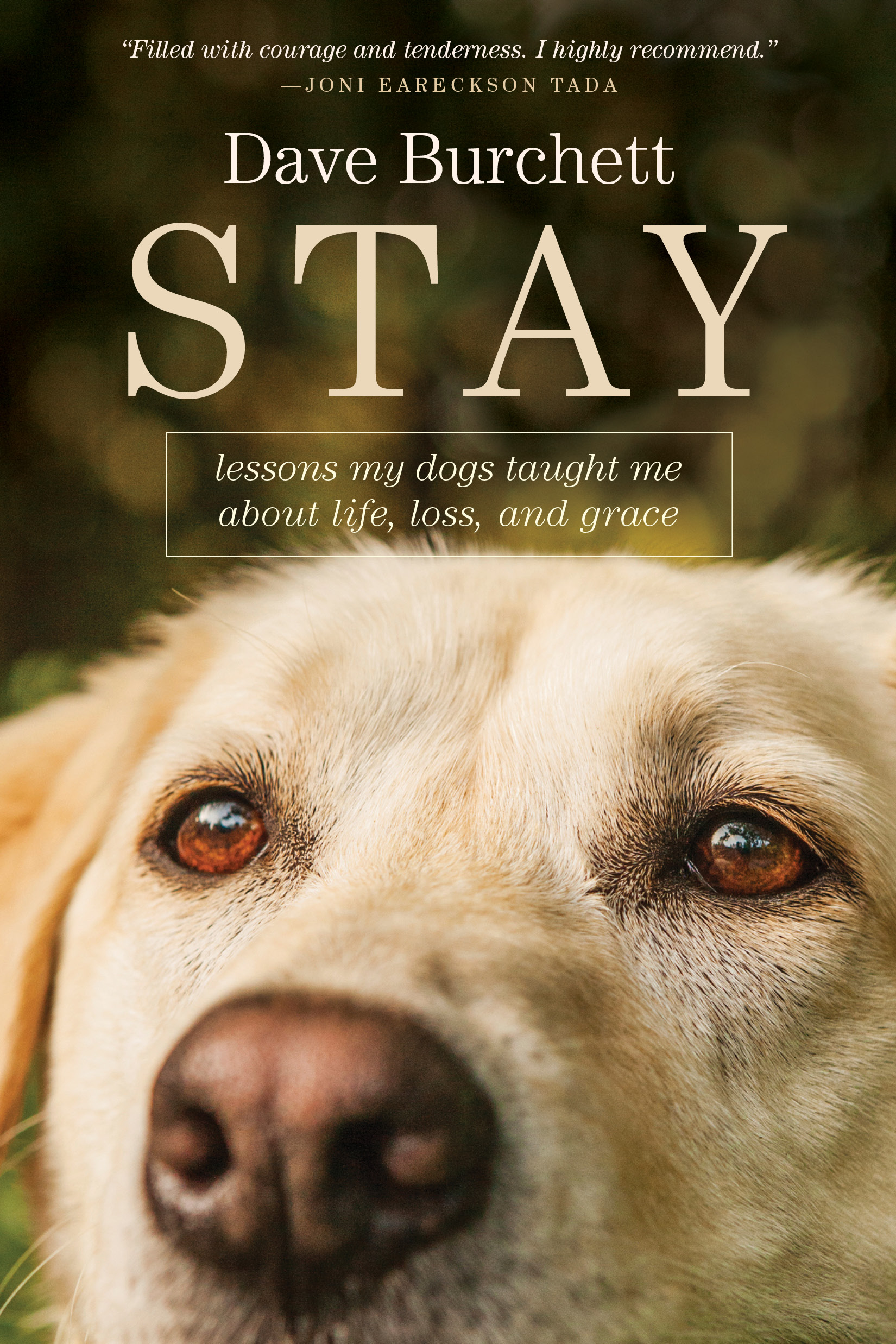
    I am so excited to announce that Stay: Lessons My Dogs Taught Me about Life, Loss, and Grace is being released in paperback on June 9th. Here is a sample chapter from that book.

    Journal Entry:

    Hannah loves the morning walk. When she sees me grab my walking shoes, she begins to vibrate with excitement. If the Department of Energy wants to find an untapped green energy source, it should harness Labrador tails. I think Hannah could power a small apartment building when she gets excited and that tail starts oscillating. I love the morning walk as well. It is a time to meditate, pray, listen to good music, and enjoy God’s company.
    The walk is pretty much the same each day for Hannah. She checks for new messages left by other canine friends along her social network. Sometimes she leaves a reply. She gets excited when she sees another person, dog, or anything breathing, really. Hannah loves life.

    As I clipped the leash to Hannah’s collar this morning, I couldn’t help but notice her enthusiasm. She was happy just to get out and walk. The leash didn’t spoil the anticipation of heading out the door, and despite its restriction, she still found abundant stimulation along the way.
    When we got to the park, it was empty. As usual, we started out by a sign that sternly warned miscreants not to let their dogs run free. Today we were in temporary violation of city code 5544.

    We entered a wooded area on the back side of the park where I felt comfortable letting Hannah run free. She became visibly energized by her liberation.

    She ran ahead of me, spun around, and sprinted back. She spotted a squirrel several yards away and instinctively froze. Her body tensed in anticipation; she crouched down and took a few slow, deliberate steps, stalking her prey.

    Then she bolted full throttle at the squirrel, ears flying in the wind.
    The squirrel darted up a tree and Hannah stopped, looked up, and then turned with an expression of complete satisfaction as she trotted back toward me. She had a doggie smile from ear to ear. Hannah was fully alive when she was off the leash. Her freedom gave her such joy and energy. The squirrels weren’t as keen with the idea.

    When we reached the front part of the park, I called her and reattached the leash. Her body language was still happy, but there was not quite as much spring in her step. The leash again restricted her freedom.
    Hannah’s joyous foray into freedom made me think about my journey with Jesus. I was introduced to faith in Christ in a church that put a legalistic leash on my daily Christian walk.

    Our church leaders reminded me of characters from the movie Monty Python and the Holy Grail. We did not have the dreaded knights who said, “Ni.” We had the dreaded pastors who said, “No.”
    I’m certain there were several volumes filled with things that were forbidden. Here is a sample platter of no-no’s I was asked to follow.
    NO movies.
    NO drinking.
    NO mixed swimming.
    NO television.
    NO cards.
    NO rock-and-roll music.
    NO smoking.
    NO slacks for women.
    NO long hair for men.
    Corollary: NO short hair for women.

    You get the idea. It’s not surprising that it took me a long time to figure out grace and freedom in Christ. Ironically, there are a few noes in the New Testament that our moralists somehow overlooked. This little “no” verse would have come in handy (capitalization and italics added for emphasis).

    There is NO condemnation for those who belong to Christ Jesus. And because you belong to him, the power of the life-giving Spirit has freed you from the power of sin that leads to death. Romans 8:1-2

    That would have been a refreshing mist of grace to our parched flock. Or how about these “no” verses (capitalization and italics added for emphasis)?
    This is how love is made complete among us so that we will have confidence on the day of judgment: In this world we are like Jesus. There is NO fear in love. But perfect love drives out fear, because fear has to do with punishment. The one who fears is not made perfect in love. We love because he first loved us. 1 John 4:17-19, NIV

    “Love the Lord your God with all your heart and with all your soul and with all your mind and with all your strength.” The second is this: “Love your neighbor as yourself.” There is NO commandment greater than these.
    Mark 12:30-31, NIV

    Love is patient and kind. Love is not jealous or boastful or proud or rude. It does not demand its own way. It is not irritable, and it keeps NO record of being wronged. It does not rejoice about injustice but rejoices whenever the truth wins out. 1 Corinthians 13:4-6

    I have been crucified with Christ and I NO longer live, but Christ lives in me. The life I now live in the body, I live by faith in the Son of God, who loved me and gave himself for me. I do not set aside the grace of God, for if righteousness could be gained through the law, Christ died for nothing!
    Galatians 2:20-21, NIV

    That is a very different “no” list than the first one.
    NO condemnation.
    NO fear.
    NO commandment greater than to love God and your neighbor.
    NO record of wrongdoing when you love one another.
    NO longer I who live but Christ who lives in me.

    Hannah’s foray off the leash reminded me again of my freedom from the burden of performance-based salvation. Remembering that restores the bounce in my step and spirit. In the freedom of grace, I am realizing and believing who God says I am. When I am unleashed by grace, I understand and trust who God says He is.

    Like Hannah, I could live on my leash of moralism and get by fairly well. I did it for decades. Most of you wouldn’t have noticed my constraints. I would still have fun and enjoy the journey, just as Hannah enjoyed the restricted part of her walk. But why should I accept partial freedom when God is offering complete freedom in His amazing grace?

    Take off whatever leash is holding you back today and run freely in grace. Choose to believe that there is no condemnation in Christ for those who belong to Him. Don’t settle for some self-imposed leash of performance. Hannah would tell you that the real blessing is running with complete freedom.

    God’s grace unhooks the leash and allows you to run unfettered and worship. God loves watching your exuberant liberation in Him. And He enjoys it when you turn and smile toward the heavens with complete satisfaction.

    Enjoy the grace-filled romp of freedom just as Hannah did. Walk (or run with ears flying) to Jesus. Approach Him with confidence, not in fear and shame. Having that relationship allows you to give up your burden of self-sufficiency and let Jesus lead.

    (Excerpted from Stay: Lessons My Dogs Taught Me about Life, Loss, and Grace)

  • The Incredible Power of Example

    The Incredible Power of Example

    Last week I speculated about the need for white mentors and leaders to step up boldly in support of our black brothers and sisters in Christ. In my latest book I wrote about a remarkable coach who was known for his absolute color blind approach to leading young men. W.T. Johnston forged a remarkable legacy. His dad Sonny was not a follower of Christ when W.T. was a youngster and it bothered him that his father would not accompany the family to church. But Sonny Johnston’s ingrained sense of justice and fairness changed his son’s life by example. Today’s excerpt from Between the White Lines is a bit longer but I hope you will find it worth your time. It is a lesson for all of us.

    Sonny Johnston grew up in a sheltered environment in rural Oklahoma. When the Korean War broke out his limited perception of the world was about to change quickly. After enlisting in the Army, nineteen-year-old Sonny’s worldview dramatically expanded. Sonny Johnston had never met, let alone lived with, a black man. He found himself in the Korean War randomly partnered in a life-or-death team relationship with an African American soldier.

    Sonny Johnston and Specialist Green
    Courtesy of Elizabeth Henderson

    Sonny later told W.T. that he never had any reservations about his comrade going into battle. Together they faced the enemy and watched out for each other. From their bunker during the bloody conflict, Specialist Green loaded mortars and Sonny fired them. The two soldiers became friends as trust developed in the heat of battle. The men learned that in adversity, it doesn’t matter what color a man’s skin might be. It only matters if he has your back. That relationship became a harbinger of how the elder Johnston would deal with racial differences in an era when many, if not most, men routinely judged others by color.

    When W.T. was seven, the family moved to Hemphill, Texas. Sonny had been promoted to became the district ranger at Sabine National Forest, a lush 160,656-acre piney woods forest that forms part of the boundary between Texas and Louisiana. Moving to a more diverse community enlarged W.T.’s world just as the military had for his dad. Johnston remembers how anxious he felt on the first day at a new school with no friends. He did not know that he would also interact with African American boys and girls for the first time in his life. Young W.T. had never encountered people who looked different from himself. He remembers feeling intimidated and even a little fearful. His father’s response to those emotions would help shape W.T.’s personality forever.

    Sonny Johnston shared the story of Specialist Green with his son. He taught him that you treat people the same way you want to be treated, and then he finished with this wise counsel. “W.T., you judge a man by character and how he treats you. It doesn’t matter what he looks like.” Sonny modeled that as a Little League coach in racially charged East Texas. “My dad never treated black kids different. Dad was a rough guy, but also giving and fair with everyone. I got the message from him loud and clear that you ain’t born prejudiced. You have to be taught that.” The lesson was driven home by a courageous defense of Curtis Hamilton, the only black youth league coach in the area. He coached W.T.’s Little League team, and the young coach was certainly talented, although perhaps a bit cocky. Hamilton had a simple philosophy. “I didn’t care if your daddy was the town drunk or the president of the bank. I played the kids who deserved to play.” That strategy didn’t sit well with some power brokers who were used to influencing those decisions, and Curtis’s color only exacerbated the tension. They wanted him out as coach. Except for Sonny Johnston. He could not understand why anyone could be so negative about a good man and coach simply because of his skin color. In the midst of the conflict that Coach Hamilton described as catching “holy hell,” the attitudes of the men suddenly changed.

    Unbeknownst to Hamilton, Sonny Johnston had called a meeting with the other fathers and coaches to discuss the young black coach. He passionately defended Hamilton by presenting facts about the progress Hamilton was making with the development of the boys. Sonny made sure race would not be the issue that would settle this debate. When Sonny Johnston bowed up, you tended to pay attention. “He came ready to reason but prepared to kick some butts,” W.T later recalled with a chuckle. The latter proved unnecessary, as Sonny convinced the men to give Curtis Hamilton a chance based on performance. “He was the only one who would stick out his neck,” Hamilton remembers with gratitude. “He changed the whole community by simply standing up for what he thought was the right thing to do. He didn’t care what the fallout might be. He just did the right thing because it was the right thing and never told me he had done it. That shows a man’s character.” In fact, Coach Hamilton was not aware of Sonny Johnston’s fiery defense until years later. Hamilton would go on to coach for the next forty-two years and be a part of two state football championships at Burkeville High School. He still wonders what would have happened if Sonny Johnston had not intervened on his behalf. “It was so discouraging. I felt all alone, and to be honest, I might have given up. I still can’t believe it was a white man from Oklahoma who had my back.”

    Sonny Johnston’s courage infiltrated the DNA of W.T. Johnston. Years later during a seventh-grade football game in Hemphill, W.T. demonstrated that he had learned from his dad’s example. Maybe his father had not been the spiritual leader that W.T. had desired, but his practical lessons about how to treat others had made a difference. Perhaps it is impossible to be truly color-blind, yet W.T. had learned from his dad that you can be color indifferent and, more importantly, color courageous. It seems outrageous today, but it was not unheard of in the ’70s for white and black athletes to drink from different water bottles. The team was integrated, but the message was obvious: The players were not equal. Their water bottles were segregated, clearly labeled. “I remember grabbing one of the black kids’ water bottles, putting my lips on the spout, and drinking deeply. Some of the white kids looked at me in horror,” Johnston recalls with a smile. “What are you doing?” a white teammate blurted. W.T.’s answer was simple. “I’m thirsty.”

    W.T. Johnston never looked for the easy or politically correct response. He learned to look for truth that would quench his thirst in every aspect of his life. That would become his lifelong quest.

    Taken from Between the White Lines

    That is the kind of courage and thirst for justice and truth that I want to define my quest to become more like Jesus. Paul talked about the importance of recognizing our influence.

    And you yourself must be an example to them by doing good works of every kind. Let everything you do reflect the integrity and seriousness of your teaching. (Titus 2:7, NLT)

    We all set an example and it is more important than we probably realize. As my friend Montagne McDonald said in last weeks article.

    “Silence says more than people think”.

    Click here if you want to read more of the story of W.T. Johnston.

  • ENOUGH! What Can I Do?

    ENOUGH! What Can I Do?

    I am saddened, sickened, and heartbroken as I keep hearing stories like the murder of Ahmaud Arbery in Georgia. I have reached the point where I believe that feeling outrage and dismay is no longer enough for followers of Jesus. I want to do something. Today I yield my space to two black brothers in Christ. Montagne McDonald is the teaching pastor at the historic King Solomon Missionary Baptist Church in Nashville, Tennessee. Duke Barnett is a respected leader and educator in Garland. I asked these two good and thoughtful men an important question. What can I do as a white brother in Christ to make a difference in our culture? Duke and Montagne, the forum is yours.

    Duke Barnett:

    For me, I wrestle with this topic because so many of my White brothers and sisters recognize the rampant inequalities, racism, and disrespect for people of color. They also recognize God’s love for people of color. However, there are many Whites (and Blacks) who call themselves Christian but are merely wolves in sheep’s clothing. So, that’s a challenge for me.

    Here is my humble opinion with some life-lived experiences sprinkled in.

    1) White people must recognize they have a members of their race/culture who despise people of color and are simply racists. Some of them are wolves in sheep’s clothing as well. They must stop making excuses for them and really just call it like it is. It’s like the old phrase, I must fix my own house before trying to fix someone else’s house.

    2) People of color must come to the realization that we are not innocent either. We often contribute to the oppression of each other. Even some of us in higher tax brackets who may not experience racism at high level, contribute to our oppression by doing things that promotes our own interests and not those of the greater good. After we make it, we sometimes tell our people to “pull yourself up by your bootstraps like I did”. That’s hard for our people when the majority has dealt with systematic racism all of our lives and we can’t buy boots. We people of color have to do better as well with taking care of our own house, race/culture No one else will do it for us.

    We have to speak truth to power and call it like it is. Not just to the other races/cultures, but mainly to our own.

    Montagne McDonald:

    Thank you for having a heart for your brothers and sisters that go beyond lip-service and church-speak. Many of our white brothers and sisters have said they hate racism and love people of color yet remain silent in times like these. It is sometimes hard to know if you have an ally when you cannot find them when they are needed. Silence says more than people think. However, beyond that it is important that our Christian brothers and sisters make an effort to also understand the theological issue of racism and injustice as well. I have heard many times from my white brothers and sisters in ministry that social justice is not of God and is in fact an enemy to Christianity. I believe there is either a misunderstanding of what social justice is, or an unwillingness to accept that there is a need for social justice. When the society we live in has police procedures and laws that make it easier for those who do not see black people as human to perpetrate violence against them, that is an injustice. When we have a judicial system that encourages stacking the deck against the poor as they await sometimes years for a “fair trial” sitting in a prison that is publicly traded, that is an injustice. Our voices should speak against it. Our votes should speak against it. You asked, “What can I do as a white brother or sister in Christ to make a difference in our culture?” You are on the right track. Using your platform to expose the weak spots of our society. Yet, beyond exposure we must seek to actively fight against the systems that continue to victimize the poor and people of color. And we must hold our brothers, sisters, judges, teachers, politicians, and pastors to a higher standard. Our country has the most morally sound ideals the world has ever seen. It is time we hold one another accountable to achieve those lofty standards: We hold these truths to be self-evident, that all men are created equal, that they are endowed by their creator with certain unalienable rights, that among these are life, liberty, and the pursuit of happiness.

    Duke Barnett:

    Prayer is an amazing connection between us and God. It’s our “intentional communication” with God! As grandma always told me…prayer changes things. But you know, many of the slaves prayed faithfully…they also took actions. Actions that were rooted in those prayers. The poor and the people of color want and need more than prayer from of White brothers and sisters. We need positive and influential action. #OneLove

    Thank you Duke and Montagne. I know I am a small fish in this social media ocean but I agree with Edward Everett Hale on this issue.

    “I am only one, but I am one. I cannot do everything, but I can do something. And because I cannot do everything, I will not refuse to do the something that I can do.”

    I want to be a voice for those without a voice. I want to call sin by it’s name and I want to offer something better. That something better is the color blind love of Jesus.

    When we were utterly helpless, Christ came at just the right time and died for us sinners. Now, most people would not be willing to die for an upright person, though someone might perhaps be willing to die for a person who is especially good. But God showed his great love for us by sending Christ to die for us while we were still sinners. (Romans 5:6-8, NLT)

    He died for us.

    All of us.

    It is time for all of us to unite in that truth and stop being silent about hate and prejudice towards our brothers and sisters.

  • Can We Quit Pointing Fingers?

    Can We Quit Pointing Fingers?

    I recently tuned my satellite radio to see what was going in Washington (D)ysfunctional (C)hildren). Within a minute I regretted my decision. Both sides were attacking and demeaning the other’s motives, integrity, and decency. My mood turned sour. Then I flipped to another channel and the first song I heard was a duet from Mandisa and TobyMac.

    These lyrics immediately grabbed my heart.

    Are you left?
    Are you right?
    Pointing fingers, taking sides
    When are we gonna realize?

    We all bleed the same
    We’re more beautiful when we come together
    We all bleed the same
    So tell me why, tell me why
    We’re divided.

    Why indeed? One thing I am sure of is that hateful rhetoric never, ever, ever changes a heart. Followers of Christ have a message of hope and light that is desperately needed. But we get caught up in the politics of our world and too often snuff out that light. I have been guilty more than I care to think about.

    I fear our culture will get darker in the days and months ahead. Followers of Christ have to make a decision. We can decide to complain that Christians are no longer respected and valued in the culture. Or we can decide to show the kind of kindness, forgiveness, grace, and love that early Christians demonstrated to change a hostile culture. Christianity really functions best as the underdog. We can ask God to give us the strength and grace to be a light in the darkness.

    What does that mean? During a British conference on comparative religions, experts from around the world debated what, if any, belief was unique to the Christian faith. They began eliminating possibilities. Incarnation? Other religions had different versions of gods’ appearing in human form. Resurrection? Again, other religions had accounts of return from death. The debate went on for some time until C. S. Lewis wandered into the room. “What’s the rumpus about?” he asked, and heard in reply that his colleagues were discussing Christianity’s unique contribution among world religions. Lewis responded, “Oh, that’s easy. It’s grace.”

    Perhaps the fact that grace and forgiveness are rare commodities in this society is a big reason we see such anger and hopelessness.

    Our natural reaction to those who denigrate our faith is to strike back. Jesus knew this would happen and He had some very radical instructions.

    “But I say to you who are listening: Love your enemies, do good to those who hate you, bless those who curse you, pray for those who mistreat you. (Luke 6:27-28,  NET)

    I wonder what God could do if we followed those words?  And if we remembered that we all created in the image of God but our different experiences and stories divide us. They don’t have to.

    If we’re gonna fight
    Let’s fight for each other
    If we’re gonna shout
    Let love be the cry
    We all bleed the same
    So tell me why, tell me why
    We’re divided

    Henri Nouwen is exactly right with this statement. “If anyone should ask you what are the most radical words in the gospel, you need not hesitate to reply: “Love your enemies.” It’s these words that reveal to us most clearly the kind of love proclaimed by Jesus.”

    It is time to quit pointing fingers. If we are going to fight let’s fight for each other. I want to represent the kind of love proclaimed by Jesus. We all bleed the same.

  • Lean On Me

    Lean On Me

    Life happens, John Lennon famously said, when you are making other plans. Boy has life been happening to us in recent weeks!


    Waterbrook Bible Fellowship chose the Monday musing topic today. Sunday’s streaming service ended with the song “Lean On Me”. The lyrics might not be found in a dusty old hymnal but the words sung by Bill Withers are spot on for this season.

    Sometimes in our lives
    We all have pain
    We all have sorrow

    Lean on me, when you’re not strong
    And I’ll be your friend
    I’ll help you carry on

    I write a lot about grace in community. Some say too much. To be honest, I have had moments when I wondered if living in community with messy people is worth it. I have come to understand why legalism is so much easier than grace. Legalism allows me to assess the situation and then apply a verse, assign a task and move away in self-righteous expectation. If that person rejects that Biblical admonition or task then legalism allows me to withdraw because they are disobedient. Grace does not give me that option. Grace demands that I move toward the struggle of my brother or sister and not away in judgment. No wonder grace is a tough sell.

    That is the glorious dichotomy of grace. Grace wears me out and lifts me up. Grace frustrates and exhilarates.  My old nature screams that people who make bad decisions over and over get what they “deserve”. They don’t “deserve” to be pursued and loved and restored. They made their bed now let them lay in it. But there is a small quiet voice in my heart that tells me that they have value. That they are loved by their Creator. And that voice asks who am I to decide who “deserves” anything?

    A quote by Pastor Paul Donnan says it far better than I ever could.

    Grace doesn’t treat us better than we deserve. It treats us without the slightest reference to what we deserve. Grace ceases to be grace if God withdraws it upon any human failure. If Grace is in any way tied to something you do, then it is no longer a gift but a wage, and that’s not grace.

    And, to be selfish, the lyrics of Bill Withers tells me why it is in my own best interest to give grace willingly.

    I’ll help you carry on
    For it won’t be long
    Till I’m gonna need
    Somebody to lean on

    Yep. It is just a matter of time until I will be begging for grace for some stupid action or word. Paul knew that was true and reminded the Galatian Church.

    Live creatively, friends. If someone falls into sin, forgivingly restore him, saving your critical comments for yourself. You might be needing forgiveness before the day’s out. Stoop down and reach out to those who are oppressed. Share their burdens, and so complete Christ’s law. If you think you are too good for that, you are badly deceived. (Galatians 6, The Message)

    Why are we so willing to receive grace and not extend it? Maybe the next lyric has a clue.

    Please swallow your pride
    If I have things you need to borrow
    For no one can fill those of your needs
    That you won’t let show

    Pride. Pride causes us to cover our needs because that would show weakness. Pride tells us to wear a mask of false joy so that others won’t know our shame and sin and need. Our Father in Heaven designed this journey to be lived in community. God knows that we need Him and we need one another. So drop the mask of false joy for the approved mask of virus prevention and sing along in muffled harmony.

    We all need somebody to lean on
    I just might have a problem
    That you’ll understand

    We all need somebody to lean on

    Yes it is hard to walk with the wounded. Yes it is frustrating to watch messy people make the same mistakes over and over. Yes it is tiring to give grace to the needy. But my heart’s desire remains the same. These words in Hebrews wrap it up nicely.

    And don’t forget to do good and to share with those in need. These are the sacrifices that please God. (Hebrews 13:16)

    Do the right thing. Help those in need. Pleasing God.

    We all need one another and especially now. Love God this week by being kind to some of His children.

    Want to be more connected to God and one another. Click here.

  • How to Choose Hope and Light over Doom and Darkness

    I remember reading Chicken Little when I was a child. The story tells that a young chick walking along was unexpectedly struck on the head by an acorn. With no further investigation Chicken Little came to the kind of well reasoned conclusion that floods our social media today.

    The sky is falling!

    Today Chicken Little would be an excellent politician or cable news anchor. Every time I violate my own personal mental health policy and turn on the news I am plunged into despair.

    The sky is falling! Look! There is an expert displaying a colorful chart to prove it! Hear me out. I know is important to communicate information for our actions and safety. But the tone and sheer volume of fear mongering is depressing.

    When I fall totally into the abyss and survey social media I see overwhelming fear, anger, gloom, and apocalyptic doom. Again, I understand the need to be informed. But I am beginning to think that fear is the most consistency ingredient for too many sources.

    As a follower of Jesus how do I process this tsunami of doom? I need to remind myself of some fundamental truths that I hold true. I find myself doing this over and over because the noise from the culture can drown out the quiet voice of the Spirit of God. Here is a small dose of my faith vaccine for fear.

    These events are NOT a surprise to God. Violence, hatred, bigotry, and division are a product of a fallen world that will someday be redeemed. Jesus made it very clear that following Him is not a get out of grief card.

    “I have told you all this so that you may have peace in me. Here on earth you will have many trials and sorrows. But take heart, because I have overcome the world.” (John 16:33, NLT)

    Yes, there will be troubles but He has overcome the world. What does that mean?

    It means even in my deepest fear and darkest hour I know that I am loved, adopted, redeemed, and I have the promise of eternity with God. I have hope to sustain me. I am not anxious to leave this world but I am also not afraid. I believe I have an eternal inheritance given as a free gift of grace awaiting me.

    I do my best to obey the laws the authorities lay out for me. I try to be a good neighbor and a responsible citizen. After doing all of those important things I stand on this conclusion drawn by David when he was afraid for his future. His lament sounds like he could have written it today (after watching cable news).

    My heart is breaking
        as I remember how it used to be:
    I walked among the crowds of worshipers,
        leading a great procession to the house of God,
    singing for joy and giving thanks
        amid the sound of a great celebration!

    David was isolated. His days of joyful gatherings were just a memory as he hunkered down alone in fear. But he remembered the key to his joy and thankfulness. He remembered where he placed his hope.

    Why am I discouraged?
        Why is my heart so sad?
    I will put my hope in God!
        I will praise him again—
        my Savior and my God!

    In Psalm 73 the author laments how the wicked seem to prosper and he wonders if his efforts are in vain. Then he recognizes the problem is not the world but the bitterness in his own heart. He acknowledges that he may face troubles but his source of strength is eternal.

    My health may fail, and my spirit may grow weak,
        but God remains the strength of my heart;
        he is mine forever. (Psalm 73:26, NLT)

    The next time the news or a social media influencer is causing your heart to be downcast remember the words of Paul to the church at Corinth.

    “For our present troubles are small and won’t last very long. Yet they produce for us a glory that vastly outweighs them and will last forever! So we don’t look at the troubles we can see now; rather, we fix our gaze on things that cannot be seen. For the things we see now will soon be gone, but the things we cannot see will last forever.”
    (2 Corinthians 4:17-18, NLT)

    Today I choose to focus my gaze on the source of hope and light.

    Jesus.

    Fear causes you to take your eye off of the source of your strength. Keep your eyes on Jesus and the words of a classic old church hymn will begin to ring true in your heart.

    O soul are you weary and troubled?
    No light in the darkness you see?
    There’s light for a look at the Savior
    And life more abundant and free

    Turn you eyes upon Jesus
    Look full in His wonderful face.
    And the things of earth will grow strangely dim
    In the light of His glory and grace.

    I pray that you will choose to focus on the hope and light of Jesus to get you through the cacophony of doom and gloom that surrounds us.